Taxation is 70 of the 450 multiple-choice questions on the CPALE — sat on Day 2 (October 25, 2026), morning session. Every one of those 70 questions is drawn from the same official blueprint: BOA Resolution No. 30, Series of 2022, the Table of Specifications that has governed the CPALE since October 2022 and continues to govern both the May and October 2026 sittings. The syllabus itself is explicit that candidates are tested on the National Internal Revenue Code (NIRC) as amended, together with BIR issuances, the Local Government Code on local taxation, and preferential tax or tax-exemption provisions — and that new laws and issuances effective as of the exam date supersede whatever the 2022 syllabus text describes, unless the Board advises otherwise. That means the area weights below stay fixed even as the underlying tax law itself is amended from one sitting to the next.
Table of Specifications
| Area | Weight | MCQs (of 70) |
|---|---|---|
| Income Taxation | 20% | 14 |
| Transfer Taxes | 17.14% | 12 |
| Business Taxes (VAT, percentage) | 17.14% | 12 |
| Principles of Taxation | 11.43% | 8 |
| Tax Remedies | 11.43% | 8 |
| Preferential Taxation | 11.43% | 8 |
| Local Government Code (LBT + RPT) | 5.73% | 4 |
| Excise Tax | 2.85% | 2 |
| Documentary Stamp Tax | 2.85% | 2 |
| Total | 100% | 70 |
Source: BOA Table of Specifications (Res. 30, s. 2022). Governs both the May and October 2026 sittings.
What Each Area Actually Covers
Income Taxation — 14 of 70 questions (20.0%)
Taxation's single heaviest area. The taxpayer and the tax base, gross income, deductions from gross income, accounting periods and accounting methods, computing tax due and available tax credits, tax return preparation and filing, and withholding taxes — at source, expanded or creditable withholding tax, final withholding tax, and withholding tax on government payments. It also covers specific provisions of other special laws relating to income taxation — the Senior Citizen's Law (RA 7432), the Magna Carta for Disabled Persons (RA 7277), and the Barangay Micro Business Enterprises (BMBE) Act (RA 9178) — and reconciling the differences between tax rules and accounting rules (e.g., PFRS or other financial reporting frameworks) to arrive at taxable income from accounting income.
Transfer Taxes — 12 of 70 questions (17.14%)
Estate tax and donor's tax together: the classification of decedents and of donors, the items included in and excluded from the gross estate, allowable deductions, net gifts and donations, computing tax due and available tax credits, tax return preparation and filing, and compliance requirements for both taxes.
Business Taxes (VAT, percentage) — 12 of 70 questions (17.14%)
Value-added tax — its nature and characteristics, the persons subject to it, transactions subject to the 12% rate, the 0% rate, withholding VAT, or exemption, the sources of input tax, computing VAT payable or excess input tax credits, and the process for claiming an input VAT refund — and percentage tax — its nature and characteristics, the persons subject to it, transactions subject to or exempt from it, and computing the tax due. This area carries the same Senior Citizen's Law (RA 7432) and Magna Carta for Disabled Persons (RA 7277) provisions as they apply specifically to business taxation.
Principles of Taxation — 8 of 70 questions (11.43%)
The nature, scope, classification, and essential characteristics of taxation; the principles of a sound tax system; the limitations on the power of taxation; tax evasion versus tax avoidance; the situs or place of taxation; double taxation; the legislation of tax laws; the impact of taxes on nation building; ethical tax compliance and administration; and the organization and functions of the Bureau of Internal Revenue, the Local Government Tax Collecting Units, the Board of Investments, the Philippine Economic Zone Authority, and the Bases Conversion and Development Authority.
Tax Remedies — 8 of 70 questions (11.43%)
The remedies available to the government, and the remedies available to the taxpayer.
Preferential Taxation — 8 of 70 questions (11.43%)
Determining tax liabilities and tax incentives under the Special Economic Zone Act (RA 7916) (income tax at the 5% gross income tax rate, income tax holiday incentives, or the regular income tax, plus other tax incentives on VAT/percentage tax, excise tax, documentary stamp tax, and local taxes), the Bases Conversion and Development Act (RA 7227) (the same incentive structure), and the Omnibus Investments Code (Executive Order No. 226) (income tax holiday incentives or the regular income tax, plus the same other incentives); and the basic principles of tax treaties and Double Taxation Agreement (DTA) models — the OECD Model Tax Convention, the UN Model Double Taxation Convention, and the United States Model Income Tax Convention — in determining the tax treatment of royalties, dividends, interest, capital gains, and business profits earned by non-residents.
Local Government Code (LBT + RPT) — 4 of 70 questions (5.73%)
The fundamental principles and scope of the taxing power of local government units under the Local Government Code (RA 7160); the scope and types of local taxes, limited to real property tax and the local taxes imposed by provinces, municipalities, cities, and barangays; the tax base and tax rates; the venue and timing of payment; and the remedies available to the government and to the taxpayer.
Excise Tax — 2 of 70 questions (2.85%)
The nature and characteristics of excise tax, the transactions subject to or exempt from it, and computing the tax base and tax due.
Documentary Stamp Tax — 2 of 70 questions (2.85%)
The nature and characteristics of documentary stamp tax, the transactions subject to or exempt from it, and computing the tax base and tax due.
Keep up with the latest tax rules.
Practice Taxation questions covering current law, with AI explanations. Seven days free, no card.
Where the Marginal Question Is
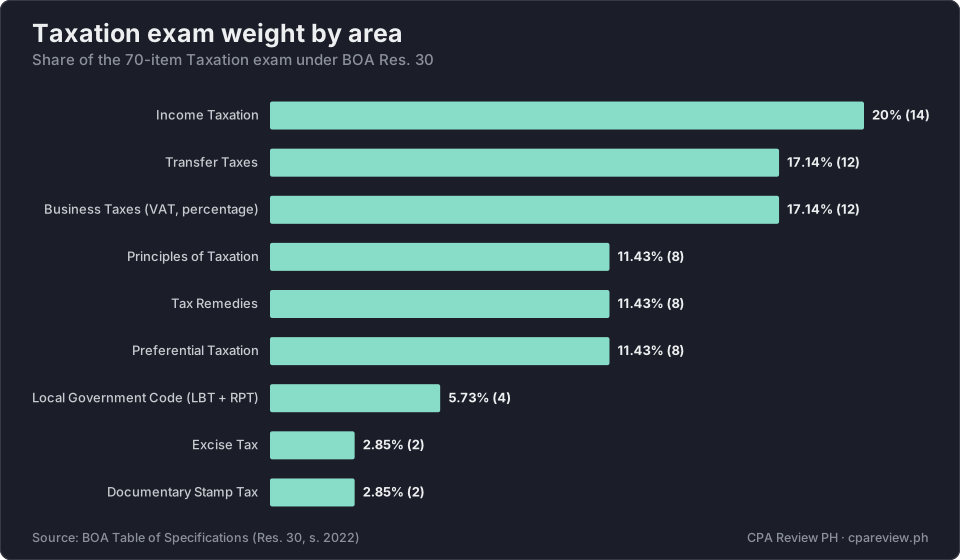
Income Taxation leads at 14 of the 70 questions, but it is far from half the exam. Transfer Taxes and Business Taxes are tied at 12 each — add those and the top three areas already account for 38 of 70, just over half the paper. Principles of Taxation, Tax Remedies, and Preferential Taxation are then tied at 8 each, meaning six of Taxation's nine areas carry real, comparable weight; only the Local Government Code, Excise Tax, and Documentary Stamp Tax drop into single-digit percentage weight — by item count, those three plus Principles, Remedies, and Preferential Taxation (8 items apiece) are all single digits.
Taxation on the October 2026 CPALE
Taxation sits on Day 2 (October 25, 2026), the morning session — 70 MCQs, the same allocation as every subject except RFBT. Filing for the October 2026 CPALE opened July 10, 2026 and closes September 9, 2026, per PRC's 2026 Schedule of Examinations.
If you already sat Taxation in May 2026 and are retaking it in October, the area weights above do not change: BOA Resolution No. 30, Series of 2022 governs both the May and October 2026 sittings. The one part of the syllabus the resolution itself tells you to expect to move is the tax law underneath those areas — the syllabus text explicitly says new laws, implementing rules and regulations, and other issuances effective as of the exam date supersede whatever the 2022 text describes. If a law changed between your May and October sittings, that change is examinable in October even though it isn't reflected in the resolution's own wording.
Related
- All six subjects: CPALE Coverage per Subject: Table of Specifications 2026 — the same Table of Specifications data for FAR, AFAR, MAS, Auditing, and RFBT, side by side.
- How to study it: Taxation Complete Guide: How to Pass Tax in the CPA Board Exam — this page tells you what is covered and how much each area is worth; that guide tells you how to actually study it.