Auditing is 70 of the 450 multiple-choice questions on the CPALE — sat on Day 1 (October 24, 2026), afternoon session, right after MAS. Every one of those 70 questions is drawn from the same official blueprint: BOA Resolution No. 30, Series of 2022, the Table of Specifications that has governed the CPALE since October 2022 and continues to govern both the May and October 2026 sittings.
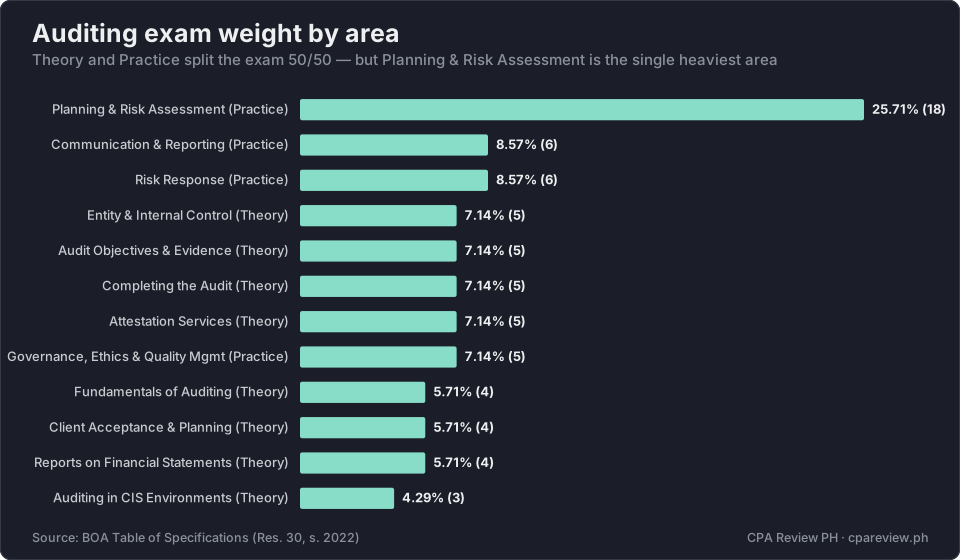
The resolution splits Auditing into two halves weighted exactly 50/50 — Theory on Auditing and Attestation Services, and Auditing Practice — eight competency areas in Theory and four in Practice. The table below merges all twelve into a single ranking by weight, so you can see which sub-area actually carries the most exam weight rather than just which half it falls under. Because the resolution's own per-area figures are rounded to one decimal place, they total 99.6% rather than a clean 100; this page instead expresses weight as the item count divided by 70 to two decimal places, which is why the column below totals 99.97% rather than 100.00%. The item counts themselves — the number that actually matters for study planning — are exact and sum to 70.
Table of Specifications
| Area | Weight | MCQs (of 70) |
|---|---|---|
| Planning & Risk Assessment (Practice) | 25.71% | 18 |
| Communication & Reporting (Practice) | 8.57% | 6 |
| Risk Response (Practice) | 8.57% | 6 |
| Entity & Internal Control (Theory) | 7.14% | 5 |
| Audit Objectives & Evidence (Theory) | 7.14% | 5 |
| Completing the Audit (Theory) | 7.14% | 5 |
| Attestation Services (Theory) | 7.14% | 5 |
| Governance, Ethics & Quality Mgmt (Practice) | 7.14% | 5 |
| Fundamentals of Auditing (Theory) | 5.71% | 4 |
| Client Acceptance & Planning (Theory) | 5.71% | 4 |
| Reports on Financial Statements (Theory) | 5.71% | 4 |
| Auditing in CIS Environments (Theory) | 4.29% | 3 |
| Total | 99.97% | 70 |
Source: BOA Table of Specifications (Res. 30, s. 2022). Governs both the May and October 2026 sittings.
Get Auditing standards down cold.
Practice Auditing questions with AI explanations grounded in the standards. Seven days free, no card.
What Each Area Actually Covers
Planning & Risk Assessment (Practice) — 18 of 70 questions (25.71%)
By far the single heaviest area in Auditing — more than a third of the Practice half on its own. Planning the audit and performing risk assessment procedures: the overview of the risk-based audit process and of risk assessment, preliminary activities including engagement acceptance and continuance, the overall audit strategy under PSA 300, determining and using materiality under PSA 320, discussion among the audit team, understanding and auditing the entity's business processes — order to cash, purchase to pay, plan to inventory, hire to retire, acquire to retire, record to report, close/consolidate/report, and financial planning and analysis — and performing risk assessment procedures at the entity-wide and business-process level under PSA 315 (Revised 2019): identifying and assessing inherent risks, understanding and evaluating internal control, communicating deficiencies in internal control, and concluding the risk assessment phase, informing the auditor's overall responses under PSA 330.
Communication & Reporting (Practice) — 6 of 70 questions (8.57%)
Audit communication and reporting: the overview of reporting, evaluating audit evidence, communicating results — the criteria and quality of communication, disseminating results, and communicating with those charged with governance under PSA 260 (Revised), and communicating internal control deficiencies under PSA 265 — preparing the audit report under the PSA 700/705/706/710 reporting series, including modifications to the auditor's report, emphasis of matter and other matter paragraphs, and comparative information, and monitoring and closing the engagement.
Risk Response (Practice) — 6 of 70 questions (8.57%)
Developing the risk-based audit plan and determining the extent of testing in response to assessed risks under PSA 330; documenting the work performed under PSA 230, including audit working papers, analysis worksheets, and the formulation of adjusting and correcting entries, and evaluating the effect of identified misstatements under PSA 450; preparing written representations under PSA 580; and engagement supervision and consultation.
Entity & Internal Control (Theory) — 5 of 70 questions (7.14%)
Understanding the entity and its environment — industry, regulatory, and other external factors, and the applicable financial reporting framework; internal control, including its basic concepts and elements, understanding and documenting accounting and internal control systems, and assessing control risk through tests of controls, all under PSA 315 (Revised 2019); assessing the risks of material misstatement from fraud and error under PSA 240, including risk assessment procedures, discussion among the engagement team, significant risks requiring special audit consideration, and revision of the risk assessment; and communicating those risks and control deficiencies with those charged with governance and management under PSA 265.
Audit Objectives & Evidence (Theory) — 5 of 70 questions (7.14%)
The nature and significance of audit objectives, evidential matters under PSA 500, including specific considerations for particular items under PSA 501, audit procedures and techniques including audit selection, and the preparation of audit working papers under PSA 230.
Completing the Audit (Theory) — 5 of 70 questions (7.14%)
Completing the audit and preparing the audit report — analytical procedures for overall review under PSA 520, related party transactions under PSA 550, the subsequent events review under PSA 560, assessing the going concern assumption under PSA 570 (Revised), obtaining the client's representation letter under PSA 580, and evaluating findings and formulating the opinion — and post-audit responsibilities: the subsequent discovery of facts and the subsequent discovery of omitted procedures.
Attestation Services (Theory) — 5 of 70 questions (7.14%)
Procedures and reports on special purpose audit engagements under PSA 800/805/810 (Revised) — audits of financial statements prepared under a comprehensive basis of accounting other than GAAP in the Philippines, audits of a component of the financial statements, reports on compliance with contractual agreements, and reports on summarized financial statements; attestation and related services — examinations of prospective financial information under PSAE 3400, engagements to review financial statements under PSRE 2400 (Revised), agreed-upon procedures engagements under PSRS 4400, engagements to prepare or compile financial information under PSRS 4410 (Revised), and service organization controls and the service auditor's report under PSAE 3402; and the role of CPAs in rendering services other than auditing and attestation.
Governance, Ethics & Quality Mgmt (Practice) — 5 of 70 questions (7.14%)
Corporate governance; the ethical standards and responsibilities of professional accountants under the Code of Ethics for Professional Accountants in the Philippines; the system of quality management under PSQM 1 (effective December 15, 2022, replacing PSQC 1) and PSQM 2 for engagement quality reviews — its elements, leadership responsibilities, ethical requirements, acceptance and continuance, human resources, engagement performance, monitoring, and documentation, together with engagement-level quality management under PSA 220 (Revised); and the regulatory requirements related to the practice, accreditation, and regulation of public accounting and auditing services.
Fundamentals of Auditing (Theory) — 4 of 70 questions (5.71%)
Introduction to assurance engagements — their nature, objective, elements, and types, namely audits, reviews, and other assurance engagements, as set out in the Philippine Framework for Assurance Engagements; and introduction to auditing itself — its nature, philosophy, and objectives under PSA 200, and the types of audit, whether classified by the nature of the assertion or data (financial statement audit, operational audit, compliance audit) or by type of auditor (external independent, internal, government).
Client Acceptance & Planning (Theory) — 4 of 70 questions (5.71%)
The risk-based financial statement audit, from client acceptance through audit planning, supervision, and monitoring: the overview of the risk-based audit process, pre-engagement procedures such as client acceptance and continuance under PSA 210, the scope and purposes of audit planning under PSA 300 — knowledge of the business, preliminary analytical procedures, materiality, assessing and managing audit risk, and the overall audit plan and program — and direction, supervision, and review of the engagement under PSA 220 (Revised).
Reports on Financial Statements (Theory) — 4 of 70 questions (5.71%)
The unqualified auditor's report and its basic elements under PSA 700 (Revised), the modified auditor's report and the matters that do and do not affect the auditor's opinion under PSA 705 (Revised) and PSA 706 (Revised), the report on comparatives under PSA 710, and key audit matters under PSA 701.
Auditing in CIS Environments (Theory) — 3 of 70 questions (4.29%)
Internal control in a computerized information systems (CIS) environment — general controls and application controls, and the unique characteristics of stand-alone, on-line, and database systems; the basic approach to auditing a CIS environment — the effects of computers on the audit process, computer-assisted audit techniques, and electronic commerce; and auditing new technologies. IT-related risks and controls have no dedicated standard of their own: the auditing standards body withdrew the old CIS-specific standard, folding its content into PSA 315 (Revised 2019) and the IT-related requirements of PSA 330, which now govern this area.
Where the Marginal Question Is
Planning & Risk Assessment alone is 18 of the 70 Auditing questions — more than a quarter of the entire subject in a single area, and more than double the next-heaviest row. Add Communication & Reporting and Risk Response, 6 each, and the top three Practice areas already account for 30 of 70 — well over 40% of the paper — before any Theory area is counted at all. The remaining 40 questions split between the fourth Practice area, Governance, Ethics & Quality Management (5), and the eight Theory areas (35 combined), which sit in narrower slices from 5 questions each down to just 3 for Auditing in CIS Environments, the lightest area on the exam.
Auditing on the October 2026 CPALE
Auditing sits on Day 1 (October 24, 2026), the afternoon session, right after MAS — 70 MCQs, the same allocation as every subject except RFBT. Filing for the October 2026 CPALE opened July 10, 2026 and closes September 9, 2026, per PRC's 2026 Schedule of Examinations.
If you already sat Auditing in May 2026 and are retaking it in October, the coverage itself does not change: BOA Resolution No. 30, Series of 2022 governs both the May and October 2026 sittings, so the table above is the same table you were tested against the first time — area for area, item for item.
Related
- All six subjects: CPALE Coverage per Subject: Table of Specifications 2026 — the same Table of Specifications data for FAR, AFAR, MAS, Taxation, and RFBT, side by side.
- How to study it: Auditing for CPA Board Exam: Complete PSA Standards Guide — this page tells you what is covered and how much each area is worth; that guide tells you how to actually study the standards themselves.