FAR (Financial Accounting and Reporting) is 70 of the 450 multiple-choice questions on the CPALE — sat on Day 3 (October 26, 2026), morning session, the last exam of the three-day cycle. Every one of those 70 questions is drawn from the same official blueprint: BOA Resolution No. 30, Series of 2022, the Table of Specifications that has governed the CPALE since October 2022 and continues to govern both the May and October 2026 sittings.
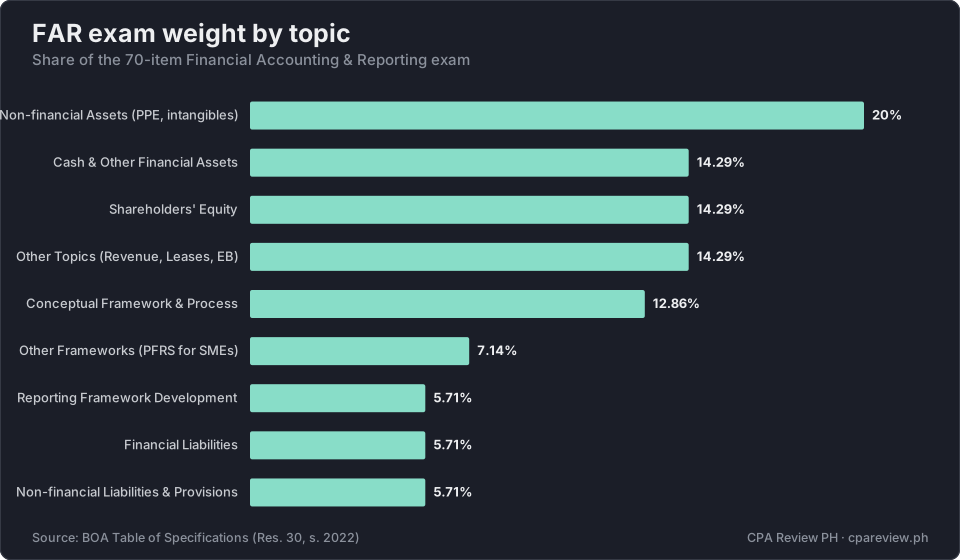
That blueprint splits FAR into nine areas, each with an exact percentage weight — and because FAR always has exactly 70 items, that percentage converts cleanly into a question count. What follows is the Board's own weighting, area by area, not a review center's rough syllabus breakdown.
Table of Specifications
| Area | Weight | MCQs (of 70) |
|---|---|---|
| Non-financial Assets (PPE, intangibles) | 20% | 14 |
| Cash & Other Financial Assets | 14.29% | 10 |
| Shareholders' Equity | 14.29% | 10 |
| Other Topics | 14.29% | 10 |
| Conceptual Framework & Process | 12.86% | 9 |
| Other Frameworks (PFRS for SMEs) | 7.14% | 5 |
| Reporting Framework Development | 5.71% | 4 |
| Financial Liabilities | 5.71% | 4 |
| Non-financial Liabilities & Provisions | 5.71% | 4 |
| Total | 100% | 70 |
Source: BOA Table of Specifications (Res. 30, s. 2022). Governs both the May and October 2026 sittings.
Make FAR your strongest subject.
Practice FAR questions with step-by-step AI explanations. Seven days free, no card.
What Each Area Actually Covers
Non-financial Assets — 14 of 70 questions (20%)
The single biggest FAR area on the exam, and it is not close. Inventories (PAS 2) — cost flow assumptions, capitalizable cost at initial recognition, subsequent measurement at the lower of cost and estimated selling price less costs to complete and sell, and the gross profit and retail inventory estimation methods. Property, Plant and Equipment (PAS 16) — the cost model vs. the revaluation model, component depreciation, and subsequent expenditure. Intangible Assets (PAS 38) — recognition criteria, internally generated vs. acquired intangibles, and amortization vs. impairment testing. Investment Property (PAS 40) — the fair value model vs. the cost model election, and reclassification to or from owner-occupied property. Impairment of Assets (PAS 36) — recoverable amount (the higher of fair value less costs of disposal and value in use), cash-generating units, and reversal of impairment losses. Biological Assets (PAS 41) — the distinction between bearer plants and agricultural produce, and their subsequent measurement. Non-current Assets Held for Sale and Discontinued Operations (PFRS 5) — classification criteria and measurement at the lower of carrying amount and fair value less costs to sell.
Cash & Other Financial Assets — 10 of 70 questions (14.29%)
Cash and cash equivalents, receivables, and investments in debt and equity securities. PFRS 9 classifies financial assets by business model and contractual cash flow characteristics into amortized cost, FVOCI, or FVTPL, with the expected credit loss model driving impairment. PAS 32 governs presentation — most testably, the liability-vs-equity classification of compound instruments like convertible bonds. PFRS 7 sets the disclosure requirements around financial instrument risk. Investments in Associates and Joint Ventures (PAS 28) — the equity method, where the carrying amount is adjusted for the investor's share of the investee's profit or loss and other comprehensive income.
Shareholders' Equity — 10 of 70 questions (14.29%)
Share capital transactions — issuance, subscription, treasury shares, retirement. Dividends — cash, property, stock, and liquidating dividends, and the distinction between the dates of declaration, record, and payment. Retained earnings — appropriated vs. unappropriated, prior-period error corrections, and quasi-reorganization and recapitalization. Other comprehensive income components and whether they reclassify to profit or loss. Computation of book value per share.
Other Topics — 10 of 70 questions (14.29%)
A catch-all label, but not a minor area — it ties for the third-heaviest slice of the exam. Expect Share-based Payment (PFRS 2) — equity-settled vs. cash-settled awards; Leases (PFRS 16) — right-of-use assets and lease liabilities from the lessee's side; Income Tax (PAS 12) — accounting profit vs. taxable profit, book basis vs. tax basis, and the computation of current and deferred tax liabilities and assets arising from temporary differences; Employee Benefits (PAS 19) — short-term benefits and defined contribution vs. defined benefit plans; Interim Reporting (PAS 34) — the purpose and components of interim financial reports, and recognizing income, expenses, assets, and liabilities for interim periods; and Operating Segments (PFRS 8) — identifying an entity's operating segments and the segment information it discloses.
Conceptual Framework & Process — 9 of 70 questions (12.86%)
The Board's full name for this area is "Conceptual Framework, Accounting Process and Presentation of Financial Statements" — two topics bundled into one. The Conceptual Framework half covers the objective of general purpose financial reporting, the qualitative characteristics (relevance and faithful representation as fundamental; comparability, verifiability, timeliness, and understandability as enhancing), the definitions and recognition criteria for the elements of financial statements, and measurement bases. The "process and presentation" half is where the financial-statement standards sit: PAS 1 (presentation, current/non-current classification) and PAS 7 (statement of cash flows, direct vs. indirect method). This area also covers the computation and disclosure of Earnings Per Share (PAS 33) — basic EPS and diluted EPS. (Subsequent events are part of the subject's general scope language — the syllabus does not itemize PAS 10 under any specific numbered area.)
Other Frameworks — 5 of 70 questions (7.14%)
Reporting for entities that do not operate at full-PFRS scale. PFRS for SMEs applies to non-publicly-accountable entities and simplifies financial instrument classification, amortizes goodwill and intangibles whose useful life cannot be reliably estimated over a default of 10 years, and expenses all borrowing costs and R&D as incurred. PFRS for Small Entities goes further, for entities with total assets or total liabilities of ₱3 million to ₱100 million, emphasizing the cost model throughout. One detail worth memorizing precisely: PFRS for Small Entities still requires a full five-statement set, including the Statement of Cash Flows — it is never optional, even in the simplified presentation that combines the Statement of Income and Statement of Changes in Equity into one statement. A third framework, reporting for microenterprises, sits below both, for entities too small even for PFRS for Small Entities.
Reporting Framework Development — 4 of 70 questions (5.71%)
The smallest-weighted area on the exam (tied with two others), but it is the foundation everything else sits on: how the Philippine financial reporting framework is developed and adopted, the role of standard-setting bodies (the Financial Reporting Standards Council domestically, the IASB internationally), and the regulation of the accountancy profession in the Philippines under RA 9298.
Financial Liabilities — 4 of 70 questions (5.71%)
Trade and other payables, and financial liabilities measured at amortized cost under PFRS 9 — bonds payable, including issuance at a premium or discount and subsequent measurement using the effective interest method, and compound financial instruments such as convertible bonds, which are split into liability and equity components on initial recognition. Troubled debt restructuring — modification of terms or asset/equity swaps when a debtor is in financial difficulty.
Non-financial Liabilities & Provisions — 4 of 70 questions (5.71%)
Provisions under PAS 37 — the recognition criteria (present obligation, probable outflow, reliable estimate) and measurement at the best estimate of the expenditure required to settle the obligation. Contingent liabilities and contingent assets, which are disclosed rather than recognized. The Board's own itemization for this area names three specific liability types alongside general provisions: liabilities arising from customer loyalty programs, warranties and product guarantees, and unearned revenue from contracts, gift certificates, and subscriptions.
Where the Marginal Question Is
Non-financial Assets alone is 14 of the 70 questions — a fifth of the entire subject in a single area. Stack it with the next two heaviest areas, Cash & Other Financial Assets and Shareholders' Equity, and the top three account for 34 of 70 — just under half the paper. A candidate who has genuinely mastered only those three areas is already positioned to get close to half of FAR right. The remaining six areas split the other 36 questions into progressively narrower slices, down to 4 questions each for the three lightest areas — real weight, but not where a review plan should spend equal time per topic.
FAR on the October 2026 CPALE
FAR sits on Day 3 (October 26, 2026), the last of the three exam days, in the morning session — 70 MCQs, the same allocation as every other subject except RFBT. Filing for the October 2026 CPALE opened July 10, 2026 and closes September 9, 2026, per PRC's 2026 Schedule of Examinations.
If you already sat FAR in May 2026 and are retaking it in October, the coverage itself does not change: BOA Resolution No. 30, Series of 2022 governs both the May and October 2026 sittings, so the table above is the same table you were tested against the first time — area for area, item for item.
Related
- All six subjects: CPALE Coverage per Subject: Table of Specifications 2026 — the same Table of Specifications data for MAS, Auditing, Taxation, RFBT, and AFAR, side by side.
- How to study it: How to Pass FAR in the CPA Board Exam — this page tells you what is covered and how much each area is worth; that guide tells you how to actually study it, week by week.