MAS (Management Services) is 70 of the 450 multiple-choice questions on the CPALE — sat on Day 1 (October 24, 2026), morning session, the very first exam of the three-day cycle. Every one of those 70 questions is drawn from the same official blueprint: BOA Resolution No. 30, Series of 2022, the Table of Specifications that has governed the CPALE since October 2022 and continues to govern both the May and October 2026 sittings. That same resolution formally renamed the subject from "Management Advisory Services" to "Management Services" — most reviewers, and this guide, still refer to it by its longtime abbreviation, MAS.
The resolution splits MAS into three broad areas at the top level — Management Accounting, Financial Management, and Economics — but those are too coarse to plan a review around (Management Accounting alone is 40 of the 70 items). The table below uses the resolution's own second-level competencies instead: thirteen rows nested under those three areas, still summing to exactly 70.
Table of Specifications
| Area | Weight | MCQs (of 70) |
|---|---|---|
| Management Accounting — Objectives, Role & Scope | 2.9% | 2 |
| Management Accounting — Planning & Control | 31.4% | 22 |
| Management Accounting — Performance Measurement | 11.4% | 8 |
| Management Accounting — Decision Making | 11.4% | 8 |
| Financial Management — Nature, Objectives & Scope | 4.3% | 3 |
| Financial Management — Financial Statement Analysis | 7.1% | 5 |
| Financial Management — Working Capital Management | 8.5% | 6 |
| Financial Management — Capital Budgeting | 7.1% | 5 |
| Financial Management — Risk and Leverage | 2.9% | 2 |
| Financial Management — Capital Structure & Long-term Financing | 2.9% | 2 |
| Financial Management — Financial Markets & Derivatives Valuation | 2.9% | 2 |
| Economics — Macroeconomics | 4.3% | 3 |
| Economics — Microeconomics | 2.9% | 2 |
| Total | 100% | 70 |
Source: BOA Table of Specifications (Res. 30, s. 2022). Governs both the May and October 2026 sittings.
Master MAS computations.
Practice MAS questions with worked AI explanations. Seven days free, no card.
What Each Area Actually Covers
Management Accounting — Objectives, Role & Scope — 2 of 70 questions (2.9%)
The objectives, role, and scope of management accounting, and how it is differentiated from cost accounting and financial accounting; the roles and activities of the controller and the treasurer; international certifications in management accounting; and global trends in the field.
Management Accounting — Planning & Control — 22 of 70 questions (31.4%)
MAS's single heaviest row, by a wide margin — practically a third of the entire subject. Cost terms, concepts, and cost behavior (variable, fixed, semi-variable/mixed, step-cost), and the techniques used to split mixed costs (high-low, scatter graph, least-squares regression) and to predict them (correlation, regression analysis, learning curves); cost-volume-profit (CVP) analysis — break-even point, target profit, sensitivity analysis, sales mix in multi-product companies, margin of safety, and degree of operating leverage; standard costing and variance analysis for direct materials (quantity, price, purchase price, mix, and yield), direct labor (efficiency, rate, mix, and yield), and factory overhead (two-way, three-way, and four-way methods); variable versus absorption costing, including reconciling operating income between the two; and financial planning and budgets — the master budget and its components, the types of budgets (static, flexible, zero-based, continuous), and budget variance analysis.
Management Accounting — Performance Measurement — 8 of 70 questions (11.4%)
Responsibility accounting and transfer pricing — decentralization, segment reporting, goal congruence, controllable versus non-controllable costs, the four types of responsibility centers, segmented income statements, return on investment (ROI), residual income, and economic value added (EVA), plus the transfer pricing schemes (minimum, market-based, cost-based, negotiated); and the balanced scorecard — its four perspectives, and the financial and non-financial performance measures (productivity, cycle efficiency, throughput) used to evaluate and improve business performance.
Management Accounting — Decision Making — 8 of 70 questions (11.4%)
Relevant costing and differential analysis — identifying relevant costs, the concept of opportunity cost, and the standard menu of non-routine decisions (make or buy, accept or reject a special order, continue or shut down, sell or process further, best product combination, pricing decisions); and quantitative decision tools — probability analysis using expected value, decision tree diagrams, and linear programming under the graphic and algebraic methods.
Financial Management — Nature, Objectives & Scope — 3 of 70 questions (4.3%)
The nature, purpose, and scope of financial management, and the role of the financial manager in investment, operating, and financing decisions.
Financial Management — Financial Statement Analysis — 5 of 70 questions (7.1%)
Vertical analysis (common-size statements) and horizontal analysis (trend percentages, index analysis); cash flow analysis, including the free cash flow concept; gross profit variance analysis by price, cost, and volume factors; financial ratios spanning liquidity, solvency, activity, profitability, and growth, plus the Du Pont model; and financial forecasting using the additional funds needed (AFN) method.
Financial Management — Working Capital Management — 6 of 70 questions (8.5%)
Working capital investment and financing policies — conservative, aggressive, and the hedging/moderate approach; cash and marketable securities management, including the cash conversion cycle, optimal cash balance, and collection and disbursement float; receivables management, including the average investment in receivables and evaluating discount, collection, and credit policies; inventory management, including carrying, ordering, and stock-out costs, the EOQ model, safety stock, and reorder point; and the sources and cost of short-term funds — trade credit, bank loans, commercial paper, receivable factoring, credit lines, and revolving credit.
Financial Management — Capital Budgeting — 5 of 70 questions (7.1%)
Capital investment decision factors — net investment, cost of capital, cash versus accrual net returns; non-discounted techniques (payback period, accounting rate of return, bail-out payback, payback reciprocal); discounted techniques (net present value, internal rate of return, profitability index, equivalent annual annuity, the Fisher rate); and project screening, project ranking, capital rationing, and sensitivity analysis.
Financial Management — Risk and Leverage — 2 of 70 questions (2.9%)
Types of risk — business/operating and financing; measures of risk — coefficient of variation and standard deviation; and the degree of operating, financial, and total leverage.
Financial Management — Capital Structure & Long-term Financing — 2 of 70 questions (2.9%)
Basic concepts and tools of capital structure management, sources of intermediate and long-term financing (including hybrid financing), and the cost of capital — cost of long-term debt, cost of preferred shares, cost of equity, and the weighted average cost of capital.
Financial Management — Financial Markets & Derivatives Valuation — 2 of 70 questions (2.9%)
Money markets and the types of money market instruments; the capital market's fixed-income segment and its basic valuation; and the stock market, including equity instruments and their basic valuation.
Economics — Macroeconomics — 3 of 70 questions (4.3%)
National economic issues and measures of economic performance: GDP, the business cycle, unemployment and inflation, fiscal and monetary policy, and international trade and foreign exchange rates.
Economics — Microeconomics — 2 of 70 questions (2.9%)
The factors affecting supply and demand, market equilibrium, price elasticity of demand, market structure, and production and cost functions.
Where the Marginal Question Is
Management Accounting — Planning & Control alone is 22 of the 70 MAS questions — nearly a third of the entire subject in a single row. Add Performance Measurement and Decision Making, 8 each, and the top three Management Accounting rows already account for 38 of 70 — more than half of MAS — before Financial Management or Economics enter the picture at all.
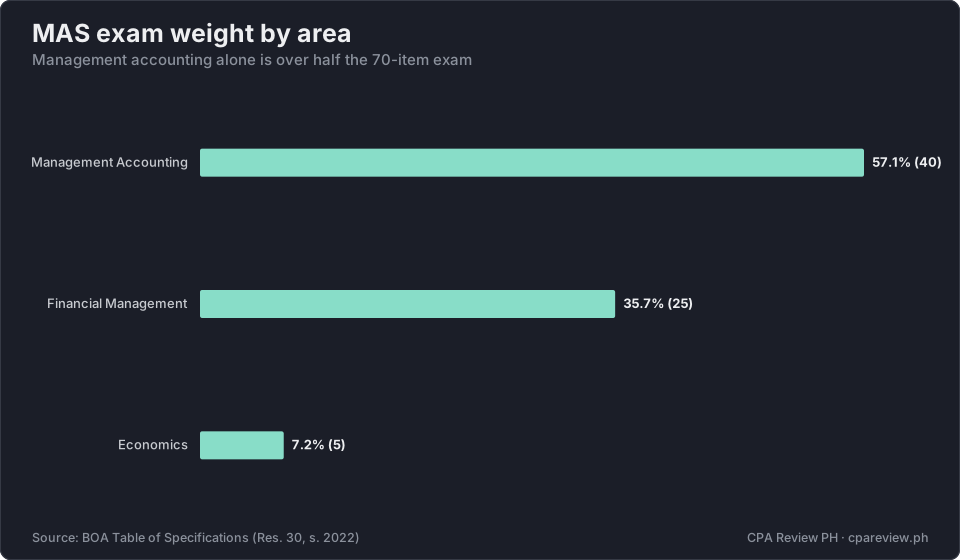
Zoomed out to the resolution's three top-level areas — the level the chart below plots, rather than the thirteen-row table above — the same imbalance holds: Management Accounting is 40 of the 70 items on its own, more than Financial Management (25) and Economics (5) combined.
MAS on the October 2026 CPALE
MAS sits on Day 1 (October 24, 2026), the morning session — the first exam of the three-day cycle, 70 MCQs, the same allocation as every subject except RFBT. Filing for the October 2026 CPALE opened July 10, 2026 and closes September 9, 2026, per PRC's 2026 Schedule of Examinations.
If you already sat MAS in May 2026 and are retaking it in October, the coverage itself does not change: BOA Resolution No. 30, Series of 2022 governs both the May and October 2026 sittings, so the table above is the same table you were tested against the first time — area for area, item for item.
Related
- All six subjects: CPALE Coverage per Subject: Table of Specifications 2026 — the same Table of Specifications data for FAR, AFAR, Auditing, Taxation, and RFBT, side by side.
- How to study it: How to Pass MAS in the CPA Board Exam: Complete Guide — this page tells you what is covered and how much each area is worth; that guide tells you how to actually study it.