One of the most common questions from CPALE reviewees is: "What exactly is covered in the exam?" Knowing the precise scope of each subject lets you focus your review time on topics that actually appear in the board exam, instead of studying material that will not be tested.
This guide breaks down the coverage of all 6 CPALE subjects based on BOA Resolution No. 30, Series of 2022, which took effect starting the October 2022 CPALE.
Looking ahead: The CPALE structure changes in 2029. A new Board resolution merges FAR and AFAR, replaces MAS with Business Analysis and Reporting, and adds a brand-new Information Systems and Controls subject — all effective the October 2029 exam. If you're taking the board before 2029, this guide still applies to you. See the complete 2029 CPALE changes guide.
Exam Structure Overview
| Day | Session | Subject | Items | Duration |
|---|---|---|---|---|
| Day 1 | AM | MAS | 70 MCQs | 4 hours |
| Day 1 | PM | Auditing | 70 MCQs | 4 hours |
| Day 2 | AM | Taxation | 70 MCQs | 4 hours |
| Day 2 | PM | RFBT | 100 MCQs | 4 hours |
| Day 3 | AM | FAR | 70 MCQs | 4 hours |
| Day 3 | PM | AFAR | 70 MCQs | 4 hours |
Total: 450 MCQs | Passing: 75% overall average, no subject below 65%
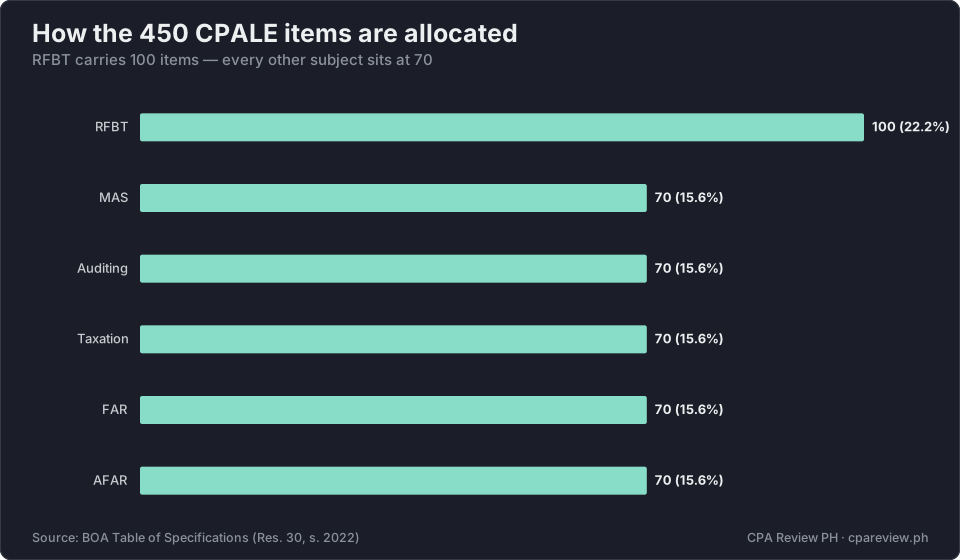
RFBT is the single biggest subject on the exam — 100 items, more than a fifth of everything you will answer across the three days.
Planning your review? Check our 3-month and 6-month study schedule to allocate time across subjects based on their weight and difficulty.
1. FAR (Financial Accounting and Reporting) — 70 MCQs
FAR is widely considered one of the most content-heavy CPALE subjects. It tests your knowledge of the full financial reporting framework, from the Conceptual Framework through specific PFRS/PAS standards.
For a deeper dive, see our complete FAR study guide.
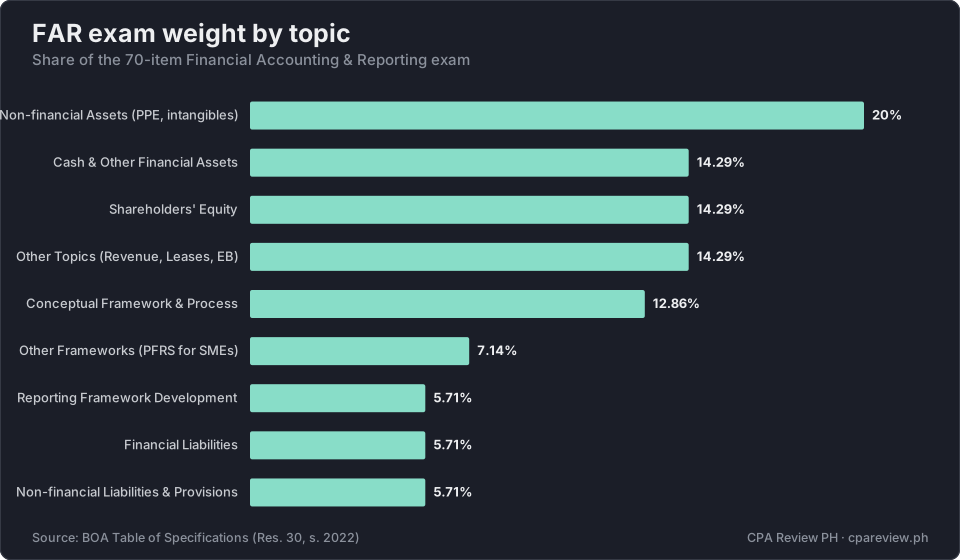
Non-financial assets lead at 20%, but no single FAR area dominates — the exam rewards breadth over a narrow bet.
Financial Reporting Framework
- Development and evolution of the financial reporting framework
- Standard-setting bodies (FRSC, IASB, FASB)
- Regulation of the accountancy profession in the Philippines
Conceptual Framework
- Objectives of general-purpose financial reporting
- Qualitative characteristics (fundamental and enhancing)
- Elements of financial statements (assets, liabilities, equity, income, expenses)
- Recognition and derecognition criteria
- Measurement bases (historical cost, fair value, present value)
- Presentation and disclosure concepts
Financial Assets (PFRS 9, PAS 32, PFRS 7)
- Cash and cash equivalents
- Trade and other receivables (allowance methods, factoring, pledging)
- Investments in debt and equity securities
- Financial instruments — classification, measurement, and impairment
- Hedge accounting basics
Non-Financial Assets
| Topic | Key Standard |
|---|---|
| Inventories | PAS 2 — cost formulas, NRV, write-downs |
| Property, Plant & Equipment | PAS 16 — cost model, revaluation model, depreciation |
| Intangible Assets | PAS 38 — internally generated vs. acquired, amortization |
| Investment Property | PAS 40 — fair value vs. cost model |
| Biological Assets | PAS 41 — agriculture, fair value measurement |
| Impairment of Assets | PAS 36 — indicators, recoverable amount, CGUs |
| Non-current Assets Held for Sale | PFRS 5 — classification and measurement |
Financial Liabilities & Provisions (PFRS 9, PAS 37)
- Trade and other payables
- Financial liabilities at amortized cost (bonds payable, compound instruments)
- Provisions — recognition criteria and measurement
- Contingent liabilities and contingent assets
- Customer loyalty programs and warranties/product guarantees
- Unearned revenue from gift certificates and subscriptions
Shareholders' Equity
- Share capital transactions (issuance, treasury shares, retirement)
- Dividends (cash, property, stock, liquidating)
- Retained earnings (appropriated and unappropriated)
- Other comprehensive income components
Other Topics (PFRS 2, PFRS 16, PAS 12, PAS 19, PAS 34, PFRS 8)
- Share-based payment (equity-settled, cash-settled, and equity-settled-with-cash-alternative awards)
- Leases — right-of-use assets and lease liabilities (lessee); direct-finance, dealer, and operating leases (lessor)
- Income tax — current and deferred tax, book basis vs. tax basis, deferred tax assets and liabilities
- Employee benefits — defined contribution vs. defined benefit plans
- Interim reporting — purpose, components, and recognition for interim financial reports
- Operating segments — identifying segments and the information disclosed
Financial Statement Presentation
| Statement | Key Standard | Focus Areas |
|---|---|---|
| Statement of Financial Position | PAS 1 | Current/non-current classification |
| Statement of Comprehensive Income | PAS 1 | Single vs. two-statement approach |
| Statement of Cash Flows | PAS 7 | Direct and indirect methods |
| Statement of Changes in Equity | PAS 1 | Reconciliation of equity components |
| Accounting Policies & Estimates | PAS 8 | Changes and error corrections |
| Events After Reporting Period | PAS 10 | Adjusting vs. non-adjusting events |
| Earnings Per Share | PAS 33 | Basic and diluted EPS |
| Leases | PFRS 16 | Right-of-use assets, lease liabilities |
Going deeper on FAR? FAR Syllabus 2026: CPALE Coverage and Table of Specifications breaks all 9 areas down to the exact number of questions each is worth.
2. Auditing — 70 MCQs
Auditing covers both theory (PSA standards, professional ethics) and practical application (audit procedures, working papers, adjusting entries). Our PSA standards guide provides additional detail.
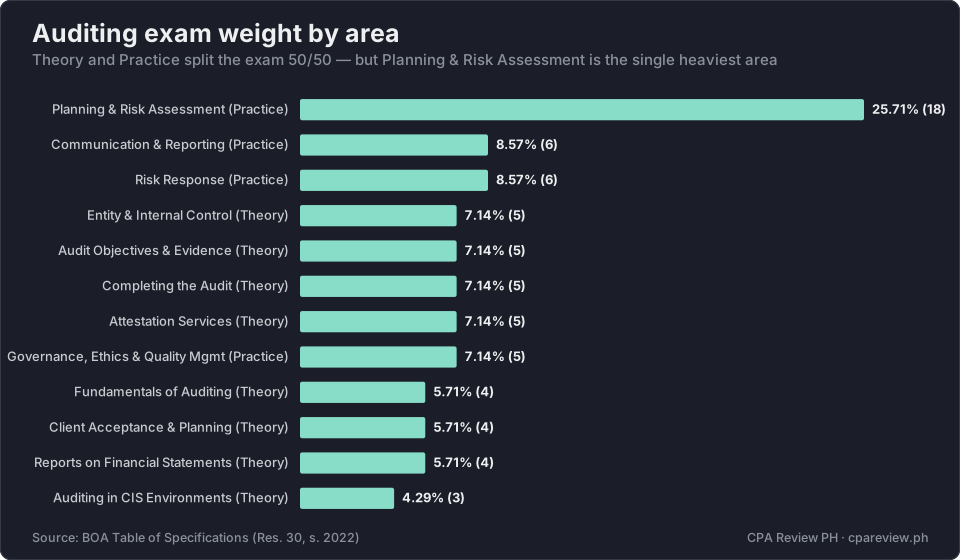
Theory and Practice split the exam evenly at 50% each, but once you merge the sub-areas, Planning & Risk Assessment (Practice) stands alone as the heaviest single topic.
Fundamentals of Assurance
- Nature and objectives of assurance engagements
- Types of audits (financial statement, compliance, operational)
- Responsibilities of the independent auditor
- Relationship between auditing and accounting
Philippine Standards on Auditing (PSA)
Planning and Risk Assessment:
| PSA | Topic |
|---|---|
| PSA 200 | Overall objectives of the independent auditor |
| PSA 210 | Agreeing the terms of audit engagements |
| PSA 220 (Revised) | Quality management for an audit of financial statements |
| PSA 230 | Audit documentation |
| PSA 240 | Auditor's responsibilities relating to fraud |
| PSA 250 | Consideration of laws and regulations |
| PSA 260 | Communication with those charged with governance |
| PSA 300 | Planning an audit of financial statements |
| PSA 315 | Identifying and assessing risks of material misstatement |
| PSA 320 | Materiality in planning and performing an audit |
| PSA 330 | Auditor's responses to assessed risks |
Audit Evidence:
| PSA | Topic |
|---|---|
| PSA 500 | Audit evidence |
| PSA 501 | Specific considerations for selected items |
| PSA 505 | External confirmations |
| PSA 510 | Initial audit engagements |
| PSA 520 | Analytical procedures |
| PSA 530 | Audit sampling |
| PSA 540 | Auditing accounting estimates |
| PSA 550 | Related parties |
| PSA 560 | Subsequent events |
| PSA 570 | Going concern |
| PSA 580 | Written representations |
Audit Reporting:
| PSA | Topic |
|---|---|
| PSA 700 | Forming an opinion and reporting |
| PSA 705 | Modifications to the opinion (qualified, adverse, disclaimer) |
| PSA 706 | Emphasis of matter and other matter paragraphs |
| PSA 710 | Comparative information |
| PSA 720 | Auditor's responsibilities for other information |
Quality Management
- Quality management standards (PSQM 1 and PSQM 2) — firm-level and engagement-level quality management, which replaced the former PSQC 1
- Engagement quality reviews
Professional Ethics
- Code of Ethics for Professional Accountants in the Philippines
- Independence (in mind and in appearance)
- Confidentiality and professional secrecy
- Conflicts of interest
- Professional competence and due care
Practical Audit Application
- Audit working paper preparation and organization
- Audit procedures for major account balances (cash, receivables, inventory, PPE, payables, equity)
- Formulating adjusting and reclassifying journal entries
- Analyzing data for errors and irregularities
- Completing the audit engagement
Going deeper on Auditing? Auditing Syllabus 2026: CPALE Coverage and Table of Specifications breaks all 12 areas down to the exact number of questions each is worth.
3. MAS (Management Advisory Services) — 70 MCQs
MAS is weighted toward management accounting (roughly half the items), with the rest covering financial management and management consultancy concepts.
For key formulas, bookmark our MAS formulas cheat sheet.
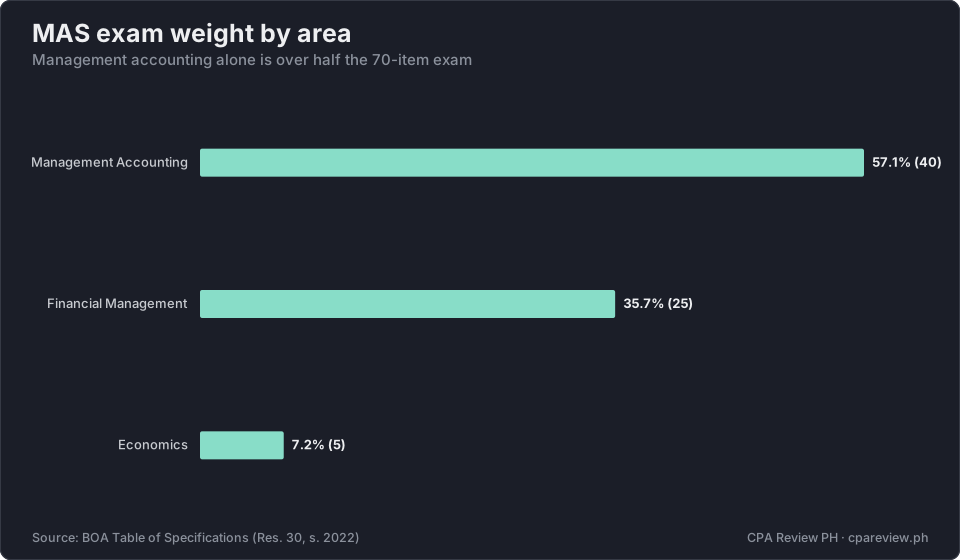
Management accounting is 40 of the 70 items on its own. Economics, at 5 items, is the smallest of the three MAS areas.
Cost Accounting Fundamentals
- Cost concepts and terminology
- Cost classification (by function, behavior, traceability, relevance)
- Cost behavior analysis (fixed, variable, mixed, step costs)
- Product costs vs. period costs
- Manufacturing overhead allocation
Costing Methods
| Method | Key Concepts |
|---|---|
| Standard Costing | Setting standards, variance analysis |
Standard Costing and Variance Analysis
- Setting standard costs (materials, labor, overhead)
- Material price and quantity variances
- Labor rate and efficiency variances
- Variable and fixed overhead variances (spending, efficiency, volume)
- Variance investigation and disposition
Cost-Volume-Profit Analysis
- Break-even analysis (units and pesos)
- Contribution margin ratio
- Target profit analysis
- Margin of safety
- Operating leverage
- Multi-product CVP analysis (sales mix)
Budgeting and Planning
- Master budget components (sales, production, purchases, cash)
- Static vs. flexible budgets
- Zero-based budgeting
- Continuous/rolling budgets
- Budget variance analysis
- Responsibility accounting
Strategic Cost Management
- Total Quality Management (TQM)
- Just-in-Time (JIT) systems
- Theory of Constraints
- Target costing and Kaizen costing
- Product life cycle costing
- Business process reengineering
- Balanced Scorecard
Financial Statement Analysis
- Liquidity ratios (current, quick, cash)
- Profitability ratios (ROA, ROE, profit margins)
- Efficiency ratios (turnover ratios)
- Solvency ratios (debt-to-equity, interest coverage)
- DuPont analysis
- Trend and common-size analysis
Working Capital Management
- Cash management (Baumol model, Miller-Orr model)
- Receivables management (credit policies, aging analysis)
- Inventory management (EOQ, reorder point, safety stock)
- Short-term financing options
Capital Structure and Financing
- Cost of capital (WACC, cost of equity, cost of debt)
- Capital structure theories (Modigliani-Miller)
- Leverage analysis (DOL, DFL, DTL)
- Long-term financing options (debt vs. equity)
Capital Budgeting
- Net Present Value (NPV)
- Internal Rate of Return (IRR)
- Payback period and discounted payback
- Profitability Index
- Modified IRR (MIRR)
- Project ranking and selection
- Risk analysis in capital budgeting
Going deeper on MAS? MAS Syllabus 2026: CPALE Coverage and Table of Specifications breaks all 13 areas down to the exact number of questions each is worth.
Put this into practice.
AI tutor and a 6-subject question bank, built for the CPALE. Seven days free, no card.
4. Taxation — 70 MCQs
Taxation is heavily based on the National Internal Revenue Code (NIRC) as amended by the TRAIN Law, CREATE / CREATE MORE Act, the Ease of Paying Taxes (EOPT) Act (RA 11976, effective 2024), and the Capital Markets Efficiency Promotion Act (CMEPA, RA 12214, effective July 1, 2025). See our TRAIN Law and CREATE MORE Act guide for detailed coverage of recent amendments. The May 2026 CPALE was the first cycle to test CMEPA changes; expect CMEPA to remain a recurring testable area in subsequent sittings.
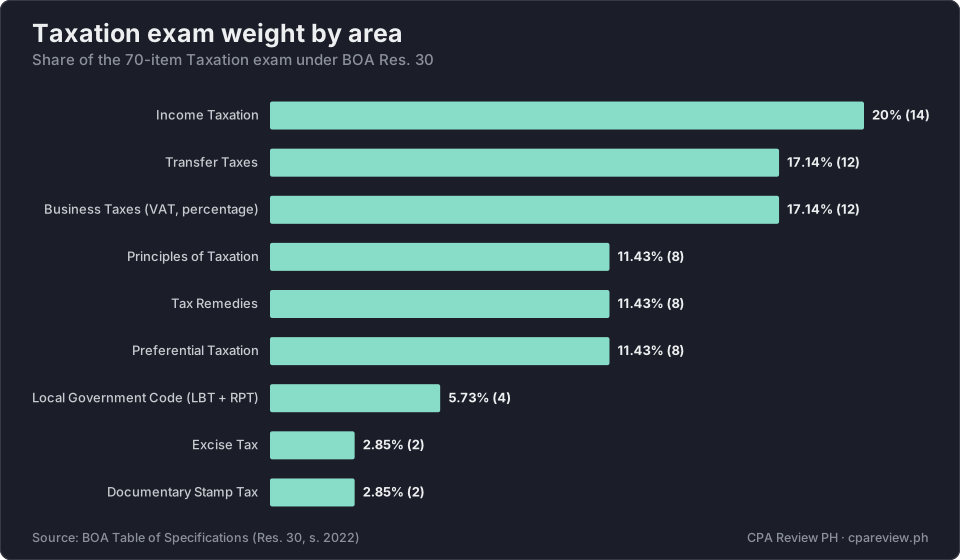
Income taxation leads at 20%, but it is far from half the exam — five other areas carry at least 11.43% each.
Tax Fundamentals
- Principles and limitations of taxation
- Inherent powers of the state (taxation, police power, eminent domain)
- Tax administration and the BIR
- Tax classifications (national vs. local, direct vs. indirect)
- Situs of taxation
Income Taxation — Individuals
- Classification of individual taxpayers (citizen, resident alien, non-resident alien)
- Graduated income tax rates (as amended by TRAIN Law)
- Compensation income taxation
- Business and professional income
- 8% flat income tax option for self-employed
- Passive income subject to final tax
- Capital gains taxation
Income Taxation — Corporations
- Classification of corporate taxpayers
- Regular Corporate Income Tax (RCIT) — 25%, or 20% for MSMEs with ≤ PHP 5M net taxable income and ≤ PHP 100M total assets (CREATE / CREATE MORE Act)
- Minimum Corporate Income Tax (MCIT) — 2% (reverted from CREATE Act's temporary 1% relief on July 1, 2023; CREATE MORE Act did not extend the lower rate)
- Special corporations (proprietary educational institutions, hospitals, GOCCs)
- Improperly accumulated earnings tax (repealed by CREATE Act, RA 11534)
- Branch profit remittance tax
Capital Markets Efficiency Promotion Act (CMEPA, RA 12214)
CMEPA took effect July 1, 2025 and amended several NIRC provisions tested starting with the May 2026 CPALE — expect them on every subsequent sitting:
- Stock Transaction Tax (STT) — reduced from 0.6% to 0.1% of the gross selling price on sales of listed shares
- Final Withholding Tax on FCDU / EFCDU deposits for residents — concessional 15% rate removed; interest is now subject to the regular 20% FWT
- Long-term deposit/investment interest — tiered exemption repealed; interest income is now subject to FWT
- Documentary Stamp Tax on the original issuance of shares — standardized to ₱1.50 per ₱200 of par value (0.75%), down from ₱2.00 per ₱200
- Selected DST and other capital-markets-related provisions amended to encourage trading and investment
Gross Income and Deductions
- Inclusions and exclusions from gross income
- Allowable deductions (itemized vs. optional standard deduction)
- Items not deductible
- Net operating loss carry-over (NOLCO)
- Special allowable deductions
Transfer Taxes
| Tax Type | Key Topics |
|---|---|
| Estate Tax (citizens & residents) | 6% flat rate; PHP 5M standard deduction, family home (up to PHP 10M), surviving-spouse share, other allowable deductions |
| Estate Tax (non-resident aliens) | 6% flat rate; PHP 500K standard deduction only (Sec 86(B)) — no family home or surviving-spouse deductions |
| Donor's Tax | 6% flat rate, exempt donations, stranger vs. relative |
Value-Added Tax (VAT)
- VAT-registered vs. non-VAT taxpayers
- Output tax and input tax
- Zero-rated and VAT-exempt transactions
- Filing and payment (quarterly returns only — the monthly VAT declaration, BIR Form 2550M, was removed under the TRAIN Law effective January 1, 2023)
- Withholding of VAT
Other Percentage Taxes
- Percentage tax for non-VAT taxpayers (3%)
- Franchise tax
- Amusement tax
- Tax on insurance premiums
Excise Taxes
- Alcohol and tobacco products
- Petroleum products
- Automobiles
- Sweetened beverages
- Cosmetic procedures
- Minerals and mineral products
Documentary Stamp Tax
- Taxable documents and transactions
- Rates and computation
- Exemptions
Local Taxation
- Local Government Code taxation powers
- Real property tax
- Local business tax
- Community tax
- Sharing of national taxes (IRA/National Tax Allotment)
Tax Remedies
- Government remedies (assessment, collection, distraint, levy)
- Taxpayer remedies (protest, appeal to CTA)
- Prescriptive periods for assessment and collection
- Compromise and abatement
- Tax refund and credit procedures
Going deeper on Taxation? Taxation Syllabus 2026: CPALE Coverage and Table of Specifications breaks all 9 areas down to the exact number of questions each is worth.
5. RFBT (Regulatory Framework for Business Transactions) — 100 MCQs
RFBT has the most items (100 MCQs) and covers a broad range of business laws. The Revised Corporation Code guide covers the corporate law portion in detail.
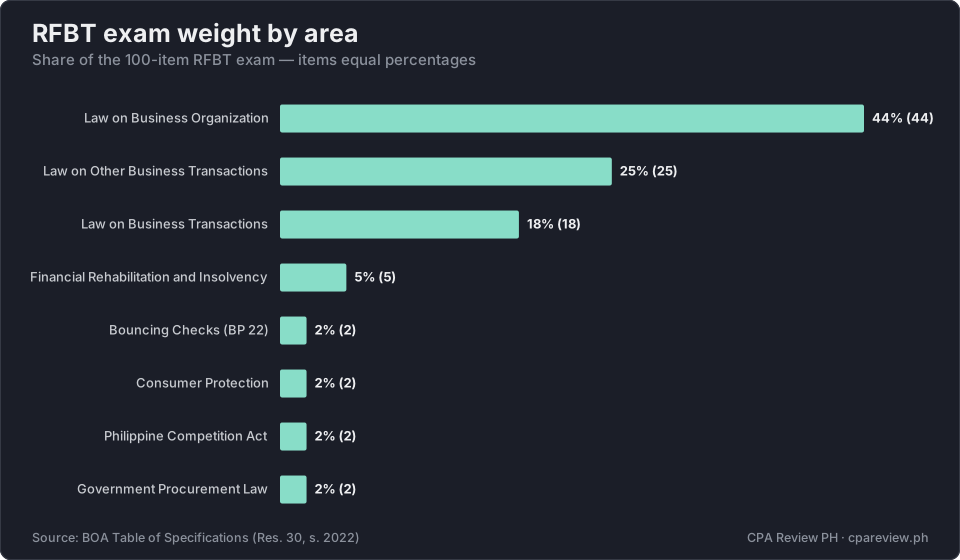
Because RFBT has exactly 100 items, each percentage is also an item count. Law on Business Organization leads at 44 items — and 30 of those are the Revised Corporation Code alone, the single largest topic anywhere in RFBT.
Obligations (Civil Code)
- Sources of obligations (law, contracts, quasi-contracts, delicts, quasi-delicts)
- Kinds of obligations (pure, conditional, with a period, alternative, joint, solidary)
- Extinguishment of obligations (payment, loss, condonation, confusion, compensation, novation)
Contracts (Civil Code)
- Essential requisites (consent, object, cause)
- Formation and perfection
- Defective contracts (rescissible, voidable, unenforceable, void)
- Interpretation of contracts
- Reformation of instruments
Law on Sales (Civil Code)
- Nature and form of the contract of sale
- Transfer of ownership and risk of loss
- Obligations of seller and buyer
- Warranties (express and implied)
- Conventional redemption and legal redemption
- Sale vs. contract to sell
Credit Transactions
| Topic | Key Concepts |
|---|---|
| Simple Loan (Mutuum) | Interest rules, usury |
| Commodatum | Gratuitous loan of non-consumables |
| Deposit | Voluntary and necessary |
| Guaranty and Suretyship | Liability, defenses, rights |
| Pledge | Movable property security |
| Real Mortgage | Immovable property security |
| Chattel Mortgage | Movable property mortgage |
| Antichresis | Fruits to apply to interest/principal |
Revised Corporation Code (RA 11232)
This is typically the heaviest-weighted topic in RFBT:
- Nature, classification, and attributes of corporations
- Incorporation process and requirements
- Corporate powers (express, implied, incidental)
- Board of directors/trustees — qualifications, duties, liabilities
- Stockholders' rights (voting, pre-emptive, appraisal, inspection)
- Stock and stockholders — classes, issuance, transfer
- Corporate officers — appointment, removal, powers
- Merger and consolidation
- Dissolution and liquidation
- Close corporations
- One Person Corporations (OPC) — new under RA 11232
- Revised provisions — perpetual corporate term, remote stockholder meetings
- Corporate governance
Partnership (Civil Code)
- Formation and characteristics
- Rights and obligations of partners
- Partnership property
- Dissolution and winding up
- Limited partnership
Agency (Civil Code)
- Creation and nature of agency
- Agent's authority (express, implied, apparent)
- Obligations of principal and agent
- Modes of extinguishment
Negotiable Instruments Law
Not in the current Table of Specifications. The Negotiable Instruments Law (Act No. 2031) carries no item allocation under BOA Resolution No. 30 — the syllabus effective October 2022. The check-related topic the RFBT TOS does weight is the Bouncing Checks Law (BP 22), at 2 of 100 items. Classical NIL remains useful foundational commercial-law knowledge and still appears in older reviewers, so it is worth understanding — but under the present LECPA, do not budget dedicated exam-weight study time to it. (Agency and Trust Receipts are in the same position: taught in most reviewers, but outside the Res 30 TOS.)
- Requisites of negotiability
- Types (promissory notes, bills of exchange, checks)
- Negotiation vs. assignment
- Holders in due course
- Liabilities of parties (maker, drawer, endorser, acceptor)
- Presentment, dishonor, notice, discharge
Insurance Code
- Elements and characteristics of insurance contracts
- Classes of insurance (life, non-life, marine, fire)
- Insurable interest
- Concealment, representation, and warranties
- Claims and payment procedures
Other Business Laws
- Securities Regulation Code (SRC) — registration, exempt securities, insider trading
- Financial Rehabilitation and Insolvency Act (FRIA, RA 10142) — rehabilitation, liquidation, suspension of payments
- Anti-Money Laundering Act (AMLA) — covered persons, covered and suspicious transactions
- General Banking Law — selected provisions
- Consumer Act of the Philippines
- Intellectual Property Code — patents, trademarks, copyrights
- Data Privacy Act — selected provisions relevant to business
Going deeper on RFBT? RFBT Syllabus 2026: CPALE Coverage and Table of Specifications breaks all 23 areas down to the exact number of questions each is worth.
6. AFAR (Advanced Financial Accounting and Reporting) — 70 MCQs
AFAR builds on FAR knowledge and covers specialized accounting topics. See our AFAR complete guide for study strategies.
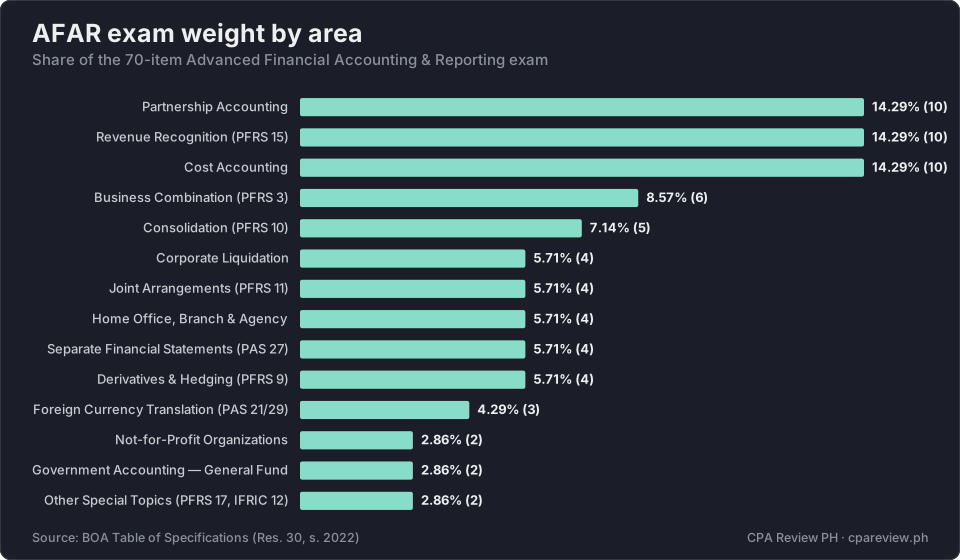
Three areas tie for the heaviest weight in AFAR — Partnership Accounting, Revenue Recognition, and Cost Accounting, each 14.29% / 10 items — with Business Combination next at 8.57% / 6 items, well behind the leaders.
Partnership Accounting
- Formation and initial investments (cash and non-cash contributions)
- Profit and loss distribution (salary, interest, bonus, remainder)
- Admission of a new partner (purchase of interest, investment)
- Withdrawal and retirement of a partner
- Partnership dissolution and liquidation (lump-sum and installment)
- Cash distribution plans and safe payments schedule
Corporate Liquidation
- Voluntary and involuntary dissolution
- Statement of affairs
- Statement of realization and liquidation
- Deficiency accounts
Joint Arrangements (PFRS 11)
- Joint operations vs. joint ventures
- Accounting by joint operators
- Accounting by joint venturers (equity method)
Business Combinations (PFRS 3)
- Acquisition method
- Identifying the acquirer
- Measuring consideration transferred
- Recognizing and measuring identifiable assets and liabilities
- Goodwill and bargain purchase
- Contingent consideration
Consolidated Financial Statements (PFRS 10)
- Control assessment (power, variable returns, linkage)
- Consolidation procedures
- Elimination of intercompany transactions (sales, services, loans, fixed assets)
- Non-controlling interests (full goodwill vs. partial goodwill)
- Changes in ownership without loss of control
- Investment in associates (PAS 28) — equity method
Foreign Currency Transactions (PAS 21)
- Functional currency determination
- Transaction date vs. settlement date
- Year-end translation of monetary items
- Translation of foreign subsidiary financial statements
- Translation adjustments in OCI
Home Office and Branch Accounting
- Reciprocal accounts
- Combined financial statements
- Billing above cost
- Shipments to/from branch
Revenue Recognition — Complex Transactions
- PFRS 15 advanced applications
- Franchise accounting
- Construction contracts (input and output methods)
- Consignment transactions
- Installment sales (cost recovery and installment methods)
Not-for-Profit Organization Accounting
- Fund accounting concepts
- Revenue recognition for NPOs
- Restricted vs. unrestricted funds
- Financial statements for NPOs
Government Accounting
Based on the Government Accounting Manual (GAM):
- Basic principles and concepts of government accounting
- Budget process for National Government Agencies (NGAs)
- Accrual basis under PPSAS (Philippine Public Sector Accounting Standards), per COA Circular 2015-007
- Journal entries for common government transactions
- Government financial statements (Statement of Financial Position, Statement of Financial Performance)
- COA rules and regulations
Cost Accounting Systems
- Cost accumulation systems — actual costing, normal costing, and standard costing
- Job-order costing — cost accumulation by job, overhead application, cost of goods manufactured and sold
- Process costing — equivalent units under FIFO and weighted-average methods
- Backflush / JIT costing — journal entries and cost determination under a just-in-time system
- Activity-based costing (ABC) — cost pools, cost drivers, and ABC vs. traditional costing
- Joint and by-product costing — joint cost allocation methods and accounting for by-products
Going deeper on AFAR? AFAR Syllabus 2026: CPALE Coverage and Table of Specifications breaks all 14 areas down to the exact number of questions each is worth.
How to Use This Guide for Your Review
-
Prioritize by weight. FAR and RFBT tend to have the most content to cover. Start with subjects you find most challenging.
-
Cross-reference with your reviewer. Check which topics your review center or study materials cover, and fill any gaps.
-
Focus on recent updates. Pay special attention to:
- PFRS 16 (Leases) in FAR, and PFRS 15 (Revenue) in AFAR
- TRAIN Law, CREATE / CREATE MORE Act, and CMEPA (RA 12214, effective July 1, 2025) amendments in Taxation
- Revised Corporation Code (RA 11232) and One Person Corporations in RFBT
- Updated PSA standards in Auditing
-
Practice with exam-style questions. Knowing the topics is not enough — you need to apply them under timed conditions. Our platform offers practice questions aligned with the latest CPALE coverage for all 6 subjects.
-
Track your weak areas. Use this guide as a checklist. Mark topics you are confident in and focus your remaining review time on gaps.
Start practicing with AI-powered CPALE questions — our system adapts to your weak areas and focuses your review where it matters most.
Sources
- BOA Resolution No. 30, Series of 2022 — Official revised syllabi and Table of Specifications
- Philippine Standards on Auditing (PSA) — Auditing and Assurance Standards Council
- National Internal Revenue Code — Bureau of Internal Revenue
- Revised Corporation Code (RA 11232) — Official text
- Government Accounting Manual — Commission on Audit
Last updated: May 12, 2026. Based on BOA Resolution No. 30, Series of 2022 (effective October 2022), with tax content updated through CMEPA (RA 12214, effective July 1, 2025). Verify any syllabus changes with PRC/BOA before the exam.