Advanced Financial Accounting and Reporting (AFAR) is widely considered the most computationally intensive subject in the CPA board exam. With 70 multiple-choice questions covering specialized accounting topics from partnerships to government accounting, strategic preparation is essential.
Understanding AFAR's Structure
Per BOA Resolution No. 30, Series of 2022, AFAR is administered on Day 3 (Afternoon Session) of the CPALE:
- Questions: 70 MCQs
- Duration: 4 hours
- Difficulty Distribution: 30% Easy, 40% Moderate, 30% Difficult
Why AFAR is Challenging
AFAR differs from FAR in several ways:
- Heavy computational focus - Most questions require calculations
- Multiple standards interaction - Business combinations involve PFRS 3, 10, and PAS 27
- Specialized areas - Government accounting follows COA rules, not PFRS
- Complex eliminations - Consolidation requires mastery of intercompany transactions
Complete Topic Coverage
Based on the official BOA syllabus, AFAR covers 14 major topic areas:
1. Partnership Accounting (14.29% of exam)
Partnership ties with Revenue Recognition and Cost Accounting for AFAR's highest weight. Master these areas:
Formation
- Initial capital contributions (cash vs. non-cash)
- Bonus and goodwill methods for admission
- Computing initial capital balances
Operations
- Profit and loss distribution methods
- Salary, interest, and bonus allocations
- Partner drawings and loans
Dissolution and Changes
- Admission of new partner (purchase vs. investment)
- Withdrawal, retirement, or death of partner
- Incorporation of partnership
Liquidation (Critical Topic)
| Method | When Used | Key Concept |
|---|---|---|
| Lump-Sum | All assets realized at once | Simple distribution after all debts paid |
| Installment | Assets sold over time | Cash priority program / safe payment schedule |
Exam Tip: Know how to handle capital deficiencies. If a deficient partner is insolvent, the deficiency is absorbed by solvent partners based on their profit-sharing ratios.
2. Business Combinations (PFRS 3) - 8.57% of exam
Business combinations under PFRS 3 use the acquisition method:
Step 1: Identify the acquirer (who obtains control)
Step 2: Determine the acquisition date
Step 3: Recognize and measure:
- Identifiable assets acquired (at fair value)
- Liabilities assumed (at fair value)
- Non-controlling interest (NCI)
Step 4: Recognize and measure goodwill or gain from bargain purchase
Goodwill Formula:
Goodwill = Consideration Transferred + NCI + Previously Held Equity Interest
           - Fair Value of Net Identifiable Assets
Bargain Purchase: When the formula results in a negative amount, recognize it as a gain in profit or loss (not negative goodwill).
3. Consolidated Financial Statements (PFRS 10) - 7.14% of exam
Per PFRS 10, a parent must consolidate all entities it controls.
The "CAR IN BIG" Mnemonic for Elimination Entries:
- C - Common Stock of subsidiary (eliminate)
- A - Additional Paid-In Capital of subsidiary (eliminate)
- R - Retained Earnings of subsidiary (eliminate)
- I - Investment in Subsidiary (eliminate)
- N - Non-controlling Interest (establish)
- B - Fair value adjustments to Balance sheet items
- I - Identifiable Intangible assets at fair value
- G - Goodwill (or Gain from bargain purchase)
Intercompany Transactions to Eliminate:
| Transaction | Elimination Required |
|---|---|
| Intercompany sales (inventory) | Eliminate unrealized profit in ending inventory |
| Intercompany land transfer | Eliminate gain/loss until sold to outsider |
| Intercompany depreciable assets | Eliminate gain/loss; adjust depreciation |
| Intercompany dividends | Eliminate against investment income |
| Intercompany loans | Eliminate receivable and payable |
4. Revenue Recognition (PFRS 15) - 14.29% of exam
The five-step model under PFRS 15:
- Identify the contract with the customer
- Identify the performance obligations in the contract
- Determine the transaction price
- Allocate the transaction price to performance obligations
- Recognize revenue when (or as) performance obligations are satisfied
Special Topics:
- Variable consideration (rebates, discounts, penalties)
- Contract modifications
- Principal vs. agent considerations
- Bill-and-hold arrangements
- Consignment sales
5. Government Accounting - 2.86% of exam
Government accounting follows the Government Accounting Manual (GAM) prescribed by COA, not PFRS.
Key Differences from Commercial Accounting:
| Aspect | Government | Commercial |
|---|---|---|
| Basis | Modified accrual (transitioning to full accrual under PPSAS) | Full accrual |
| Focus | Accountability & stewardship | Profitability |
| Standards | Philippine Public Sector Accounting Standards (PPSAS) | PFRS/PAS |
| Fund Structure | Organized by fund clusters | Single entity |
The Budget Process:
- Budget preparation (agencies submit proposals)
- Budget legislation (Congress approves GAA)
- Budget execution (agencies implement)
- Budget accountability (COA audits)
Key Journal Entries for National Government Agencies:
- Appropriations and allotments
- Obligations and disbursements
- Revenue recognition (tax and non-tax)
6. Other Important Topics
Corporate Liquidation (5.71%)
- Statement of Affairs
- Statement of Realization and Liquidation
- Order of priority of claimants
Joint Arrangements - PFRS 11 (5.71%)
- Joint operations (recognize share of assets/liabilities)
- Joint ventures (equity method)
Cost Accounting (14.29%)
- Job order costing
- Process costing (FIFO and weighted average)
- Standard costing and variance analysis
Foreign Currency (PAS 21) - 4.29%
- Functional currency determination
- Translation of foreign operations
- Exchange gains and losses
Drill AFAR until it clicks.
Practice AFAR questions with step-by-step AI explanations. Seven days free, no card.
High-Yield Topic Prioritization
Based on the official Table of Specifications (BOA Res. 30, s. 2022):
| Priority | Topic | Weight | Focus Areas |
|---|---|---|---|
| 1 | Partnership Accounting | 14.29% | Liquidation methods, profit distribution |
| 2 | Revenue Recognition | 14.29% | Five-step model, variable consideration |
| 3 | Cost Accounting | 14.29% | Process costing, job order costing |
| 4 | Business Combinations | 8.57% | Goodwill computation, acquisition method |
| 5 | Consolidated FS | 7.14% | Elimination entries, NCI computation |
| 6 | Government Accounting | 2.86% | GAM basics, budget cycle |
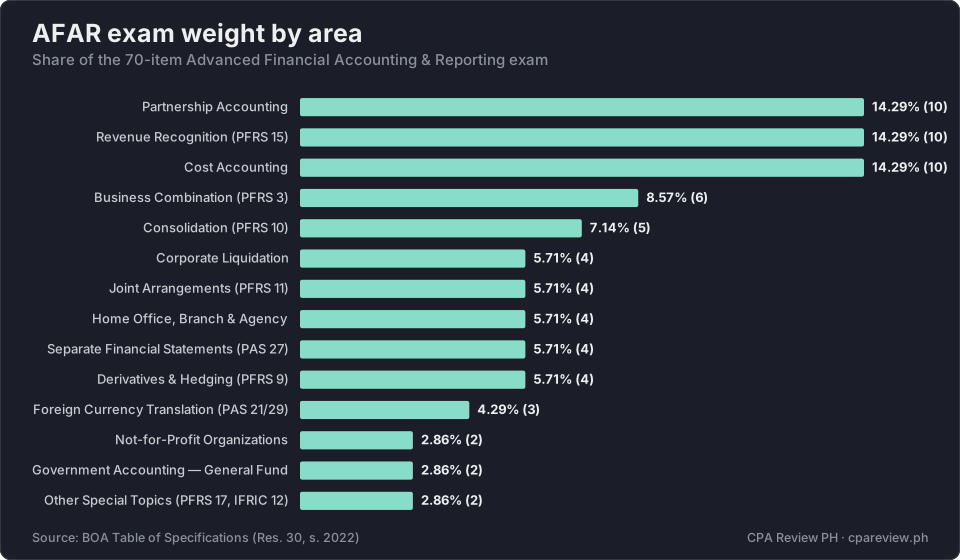
Partnership Accounting, Revenue Recognition, and Cost Accounting each carry 14.29% — together 42.87% of the exam, making them AFAR's three heaviest areas by a clear margin over Business Combinations (8.57%).
Proven Study Strategies
1. Master Partnership First
Partnership accounting appears early in most review programs for good reason:
- Foundational concepts apply to other topics
- High exam weight justifies extensive study
- Computational skills transfer to consolidation
Practice these specific problems:
- Partner admission by investment (bonus vs. goodwill method)
- Installment liquidation with cash priority program
- Safe payment schedules with deficient partners
2. Build Consolidation Skills Systematically
Don't jump straight to complex problems. Follow this progression:
- 100% ownership, no fair value adjustments - Master basic eliminations
- 100% ownership with fair value adjustments - Add inventory, land, equipment adjustments
- Less than 100% with NCI - Introduce non-controlling interest calculations
- Intercompany transactions - Add upstream and downstream eliminations
- Multiple subsidiaries - Handle complex group structures
3. Understand Government Accounting Concepts
Don't try to memorize every GAM entry. Instead:
- Understand why government accounting differs (accountability focus)
- Know the budget cycle conceptually
- Recognize common journal entries for obligations and disbursements
- Focus on fund cluster organization
4. Use the Right Formula Sheets
Create summary sheets for:
Partnership Liquidation:
Cash Available = Assets Realized - Liquidation Expenses
Cash to Partners = Cash Available - Liabilities to Outside Creditors - Liabilities to Partners
Goodwill Computation:
Consideration Transferred (FV)
+ NCI (FV or proportionate share)
+ Previously Held Interest (FV at acquisition date)
= Total
- Fair Value of Net Identifiable Assets
= Goodwill (or Gain from Bargain Purchase)
5. Time Management During the Exam
With 70 questions in 4 hours:
- Target: ~3.4 minutes per question average
- Easy questions: Complete in under 2 minutes
- Complex computations: Allow up to 4-5 minutes
- Flag and return: Don't get stuck on any single question
Common Mistakes to Avoid
Partnership
- Forgetting to include partner loans in liquidation priority
- Using wrong profit-sharing ratio for loss absorption
- Confusing bonus vs. goodwill methods
Business Combinations
- Using book value instead of fair value for net assets
- Forgetting to test goodwill for impairment (PAS 36)
- Incorrect NCI computation (FV method vs. proportionate share)
Consolidation
- Using beginning balances instead of acquisition-date balances
- Missing intercompany profit eliminations
- Incorrect direction (upstream vs. downstream) adjustments
Government Accounting
- Applying commercial PFRS principles to government entities
- Confusing budget basis with accounting basis
- Unfamiliarity with fund cluster journal entries
Recommended Study Resources
Official References:
- PFRS 3 - Business Combinations
- PFRS 10 - Consolidated Financial Statements
- PFRS 15 - Revenue from Contracts with Customers
- Government Accounting Manual (GAM)
Review Materials:
- CPAR AFAR Handouts - Concise, exam-focused
- Dayag AFAR Reviewer - Comprehensive theory and problems
- ReSA Preboards - Realistic exam simulation
Final Exam Day Tips
- Bring a reliable calculator - AFAR is computation-heavy
- Read carefully - "Cost method" vs "equity method" changes everything
- Check for reasonableness - If goodwill is negative, you may have a bargain purchase
- Manage your time - Don't let partnership liquidation problems consume 10 minutes each
- Trust your preparation - The patterns repeat; recognize them
AFAR rewards systematic preparation and computational practice. Focus on the high-yield topics, master the elimination entry patterns, and practice under timed conditions. With dedicated study, you can turn this challenging subject into a strength.
Ready to start your AFAR review? Begin your free trial and access AI-powered practice questions for all AFAR topics.