Management Advisory Services (MAS) is the subject that opens the entire CPA Licensure Examination. It tests your ability to apply accounting knowledge to business decision-making — from costing products to evaluating investments. Many reviewees underestimate MAS because it feels "less accounting" than FAR or Auditing, but the numbers tell a different story: MAS consistently has one of the lower passing rates per subject.
This guide breaks down exactly what to study, how to prioritize, and how to approach the exam strategically.
MAS Exam Structure
Per BOA Resolution No. 30, Series of 2022, MAS is administered as follows:
- Schedule: Day 1, Morning Session
- Questions: 70 MCQs
- Duration: 4 hours (approximately 3.4 minutes per question)
- Passing Score: 75% (as part of the overall CPALE average)
MAS kicks off the entire three-day exam. Your performance here sets the psychological tone for the remaining five subjects. A strong start builds confidence; a rough one can shake your focus for Auditing that same afternoon.
BOA Table of Specifications: Topic Breakdown
Per BOA Resolution No. 30, Series of 2022, the Management Services TOS recognizes only three top-level areas — not the six-way split some review materials use:
| Topic Area | Weight | Items |
|---|---|---|
| Management Accounting | 57.1% | 40 |
| Financial Management | 35.7% | 25 |
| Economics (Micro & Macro) | 7.2% | 5 |
This distribution tells you exactly where to invest your study time: Management Accounting alone is 57.1% of the exam, and together with Financial Management (35.7%) these two areas make up 92.8% of the exam. If you master them, you already have a strong foundation for passing. Within Management Accounting, review centers (including this guide) commonly split the content into familiar study blocks — cost concepts, quantitative methods, decision tools — but Res 30 does not publish separate weights for those sub-blocks; they are covered below as study topics, not as independently-weighted exam areas.
Deep Dive: Each Topic Area
1. Cost Concepts, Cost Behavior, and Cost Accounting Techniques (31.4%, 22 items)
Within Management Accounting, planning-and-control techniques — cost behavior, CVP, standard costing and variance, budgeting — form the single largest second-level sub-area under Res 30: 31.4% of the entire 70-item MAS exam (22 items). This is the heaviest and most computation-intensive portion. Expect problems on:
- Job order costing — allocation of overhead using predetermined rates
- Process costing — weighted average vs. FIFO method, equivalent units of production
- Activity-Based Costing (ABC) — cost drivers, activity cost pools, product vs. batch vs. facility-level activities
- Standard costing and variance analysis — material price/quantity variances, labor rate/efficiency variances, overhead spending/efficiency/volume variances
- Joint and by-product costing — net realizable value method, physical quantity method, split-off point decisions
- Cost-Volume-Profit (CVP) analysis — breakeven point, margin of safety, target profit analysis, multi-product CVP
High-yield tip: Variance analysis is almost guaranteed to appear. Memorize the formulas using the "three-line" method:
AQ x AP     AQ x SP     SQ x SP
    |            |            |
    Price/Rate   Quantity/Efficiency
    Variance     Variance
This works for materials, labor, and variable overhead.
2. Financial Management (35.7%)
Financial management questions test your ability to evaluate business decisions using time value of money and risk-return concepts:
- Time value of money — present value, future value, annuities, perpetuities
- Capital budgeting — NPV, IRR, payback period, profitability index, accounting rate of return
- Working capital management — cash conversion cycle, EOQ model, reorder point, safety stock
- Cost of capital — WACC, cost of equity (CAPM, dividend growth model), cost of debt (after-tax)
- Capital structure and leverage — degree of operating leverage (DOL), degree of financial leverage (DFL), combined leverage
- Dividend policy — residual dividend theory, stock dividends vs. cash dividends
Common pitfall: Confusing NPV with IRR when projects are mutually exclusive. NPV is the theoretically superior method because it assumes reinvestment at the cost of capital, not at the IRR.
3. Economics: Microeconomics & Macroeconomics (7.2%)
Economics is the area that surprises many accounting graduates because it requires a different way of thinking. Key topics include:
Microeconomics:
- Supply and demand analysis, elasticity
- Market structures: perfect competition, monopoly, monopolistic competition, oligopoly
- Consumer and producer surplus
- Production and cost functions (short-run vs. long-run)
Macroeconomics:
- GDP computation (expenditure vs. income approach)
- Fiscal policy and monetary policy (BSP tools: reserve requirements, open market operations, policy rates)
- Inflation, unemployment, and the Phillips curve
- Exchange rates and balance of payments
- Philippine economic indicators and BSP monetary policy framework
Study strategy: Economics is mostly conceptual. Focus on understanding the "why" behind each model rather than memorizing definitions. Graph interpretation questions are common — practice reading supply-demand shifts, IS-LM curves, and AD-AS diagrams.
4. Quantitative Methods and Operations Management
These techniques sit inside Management Accounting's decision-making sub-area, which totals 11.4% of the exam (8 items) together with relevant costing and capital-budgeting analysis — Res 30 does not publish a standalone weight for quantitative methods alone. This area combines math techniques with operations concepts:
- Linear programming — graphical method, simplex sensitivity analysis, shadow prices
- Probability and statistics — expected value, standard deviation, coefficient of variation, normal distribution
- Decision theory — payoff tables, expected monetary value, expected value of perfect information (EVPI)
- Inventory models — EOQ, production order quantity, quantity discounts
- Project management — PERT/CPM, critical path, expected activity time, project crashing
- Queuing theory — basic single-server formulas, arrival and service rates
- Regression and correlation — least squares method, coefficient of determination (R-squared)
- Learning curves — cumulative average-time model vs. incremental unit-time model
Formula focus: Many candidates lose points here not because they lack understanding but because they forget formulas. Create a dedicated formula sheet for quantitative methods and review it daily during your last two weeks of review.
5. Information Technology
IT does not appear anywhere in the Res 30 MAS Table of Specifications as a weighted area — this section is included because many review centers (including this guide) still cover it as MAS-adjacent content. IT questions in MAS focus on how technology supports business operations:
- Information systems concepts — TPS, MIS, DSS, EIS/ESS
- E-commerce and digital business models
- IT governance — COBIT framework, IT controls (general vs. application)
- Database concepts — relational databases, data warehousing, data mining
- Systems development — SDLC phases, prototyping, agile methodology
- Cybersecurity basics — common threats, controls, encryption concepts
- Emerging technologies — blockchain, cloud computing, AI/ML applications in accounting
IT questions are usually conceptual. Expect definition-type and scenario-based MCQs rather than computations.
6. Management and Business Strategy
Like Information Technology, Business Strategy is not a weighted area in the Res 30 MAS TOS. Though not officially weighted, do not ignore this area entirely:
- Strategic management — SWOT analysis, Porter's Five Forces, value chain analysis
- Balanced Scorecard — four perspectives (financial, customer, internal process, learning/growth)
- Benchmarking and performance measurement
- Total Quality Management (TQM) — cost of quality categories (prevention, appraisal, internal/external failure)
These are easy points if you study them. Most questions are conceptual and straightforward.
Master MAS computations.
Practice MAS questions with worked AI explanations. Seven days free, no card.
Study Strategy: A Practical Approach
Phase 1: Foundation Building (Weeks 1-3)
Focus on understanding core concepts before solving problems:
- Cost Accounting — Read through job order, process, and standard costing chapters thoroughly
- Financial Management — Master time value of money first, then capital budgeting
- Economics — Review micro before macro; ensure you understand basic supply-demand before moving to aggregate models
Phase 2: Problem Practice (Weeks 4-6)
Switch to heavy problem-solving:
- Solve at least 20-30 problems per day across cost accounting and financial management
- Time yourself: aim for under 2.5 minutes per problem
- Review errors systematically — categorize mistakes as conceptual vs. computational vs. careless
Phase 3: Integration and Mock Exams (Weeks 7-8)
- Take full 70-item mock exams under timed conditions
- Focus on your weak areas identified from Phase 2
- Do a final formula review the week before the exam
Time Allocation Guide
This guide's recommended study time allocation below is informed by each area's real Res 30 weight where one is published, and by each topic's practical study demands where it isn't:
| Topic Area | % of Study Time | Reason |
|---|---|---|
| Cost Accounting | 30% | Densest computation load — the single largest sub-area of Management Accounting (31.4% of the exam on its own) |
| Financial Management | 25% | Second-largest Res 30 area at 35.7% of the exam; complex formulas |
| Economics | 20% | Conceptual breadth needs more study time than its 7.2% exam share alone would suggest |
| Quantitative Methods | 15% | Formula-heavy but predictable |
| IT | 7% | Conceptual, easier to review |
| Business Strategy | 3% | Straightforward and quick to review |
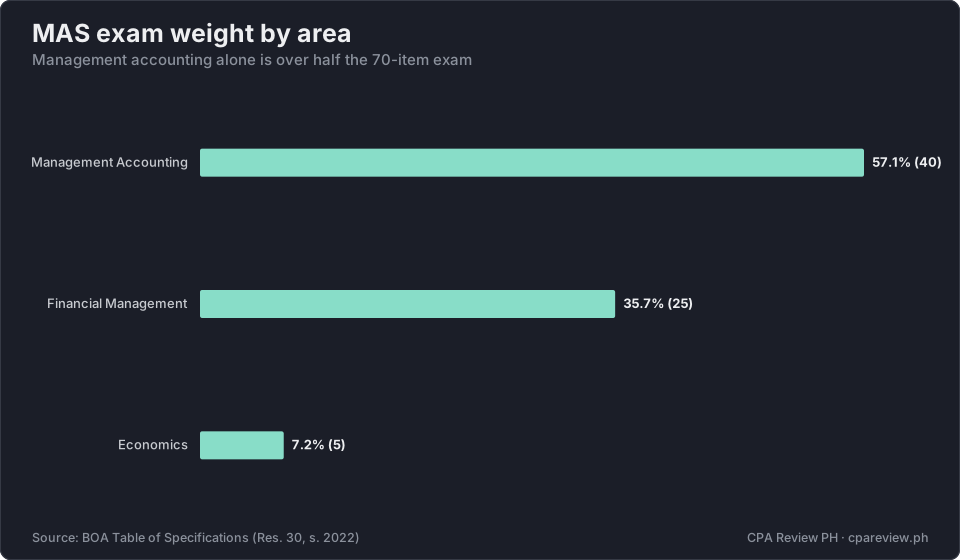
Management Accounting is over half the exam at 57.1%, Financial Management follows at 35.7%, and Economics is a comparatively small 7.2%. The study-time table above still gives cost accounting the single largest share (30%) — that tracks its real 31.4% weight as Management Accounting's biggest sub-area — while spreading the rest of your time across the remaining topics by how much practice each one demands, not by an exam weight Res 30 does not publish for them.
Formula Memorization Tips
MAS is arguably the most formula-intensive subject in the CPALE. Here are proven techniques:
Group Formulas by Category
Instead of memorizing formulas randomly, group them:
CVP Analysis Group:
- Breakeven (units) = Fixed Costs / Contribution Margin per Unit
- Breakeven (pesos) = Fixed Costs / CM Ratio
- Target Profit Units = (Fixed Costs + Target Profit) / CM per Unit
- Margin of Safety = Actual Sales - Breakeven Sales
Capital Budgeting Group:
- NPV = Sum of [CF / (1+r)^n] - Initial Investment
- IRR = rate where NPV = 0
- Payback = Years before full recovery + (Unrecovered / Cash flow in recovery year)
- PI = PV of Cash Inflows / Initial Investment
Use Mnemonics
- DOPE for leverage: DOL = %Change in Operating income / %Change in Sales; DFL = %Change in Profit / %Change in EBIT
- WACC order: Debt (cheapest, tax shield) → Preferred → Equity (most expensive)
Write Formulas Before Starting
When you sit down for the actual exam, use the first 2-3 minutes to jot down key formulas on your scratch paper while they are fresh. This reduces anxiety and prevents blanking mid-exam.
Common Pitfalls and How to Avoid Them
1. Overthinking Economics Questions
MAS economics questions are typically introductory-level. Do not read macroeconomics textbooks cover to cover. Focus on the core models and their Philippine applications.
2. Mixing Up Costing Methods
Process costing under weighted average vs. FIFO produces different equivalent units. Under weighted average, you treat beginning WIP as if started this period. Under FIFO, you only count work done this period. Label your method clearly when solving.
3. Ignoring the Time Value of Money
In capital budgeting, never compare cash flows from different periods without discounting. A common error is adding undiscounted cash flows and calling it NPV.
4. Skipping IT and Strategy
IT and Business Strategy are not weighted as separate MAS areas under Res 30, but they still show up on exam day. These are usually the easiest questions on the exam. Spending a few days reviewing IT and strategy concepts can be the difference between 74% and 76%.
5. Calculator Errors
MAS involves heavy computation. Double-check your calculator entries, especially for complex TVM problems. Use the memory function to store intermediate results instead of re-keying numbers.
Exam Day Strategy
Since MAS is the first subject on Day 1 (morning), your approach sets the tone:
-
Arrive early and settled — Do not cram outside the testing center. Review your formula sheet one last time, then put it away.
-
Quick scan first — Skim all 70 questions in the first 5 minutes. Identify easy wins (conceptual IT, strategy, basic CVP) and flag complex computations for later.
-
Answer in three passes:
- Pass 1 (45 min): Answer all questions you can solve quickly
- Pass 2 (60 min): Tackle computation-heavy problems
- Pass 3 (30 min): Return to flagged/uncertain items, review answers
-
Do not leave blanks — There is no penalty for wrong answers. If you cannot solve a problem, eliminate obviously wrong choices and make an educated guess.
-
Manage your energy — Remember, Auditing is in the afternoon. Do not exhaust yourself on a single difficult MAS problem. Mark it, move on, and return if time permits.
How CPA Review PH Can Help
CPA Review PH provides AI-powered practice for MAS with features designed for this specific subject:
- Adaptive difficulty that increases problem complexity as you improve
- Targeted weak area practice — the system identifies your weakest MAS topics and generates focused drills
- Full mock exams simulating the 70-MCQ, 4-hour format
- AI tutor that explains solutions step-by-step, including formula derivations
Final Thoughts
MAS rewards consistent, methodical preparation. The subject is wide but not impossibly deep — you do not need to be an economics major or an IT expert. You need to be solid in Management Accounting and Financial Management (together 92.8% of the exam), competent in Economics (7.2%), and familiar with quantitative methods, IT, and strategy concepts, which fall inside Management Accounting's broader scope without a separate published Res 30 weight.
Start early, practice daily, and track your progress. The formulas will stick, the patterns will emerge, and you will walk into that Day 1 morning session ready.
Good luck, future CPA.