Taxation is one of the most feared subjects in the CPA Licensure Examination, and for good reason. It demands memorization of tax rates, thresholds, deadlines, and rules — many of which have been overhauled by the TRAIN Law (RA 10963) and the CREATE MORE Act (RA 12066). But Taxation is also one of the most rewarding subjects to master because the rules, once learned, are remarkably systematic.
This guide covers every major topic area, highlights the legislative changes you need to know, and gives you a practical study strategy.
Taxation Exam Structure
Per BOA Resolution No. 30, Series of 2022, Taxation is administered as follows:
- Schedule: Day 2, Morning Session
- Questions: 70 MCQs
- Duration: 4 hours (approximately 3.4 minutes per question)
- Passing Score: 75% (as part of the overall CPALE average)
Taxation falls on Day 2 morning, with RFBT in the afternoon. This is arguably the heaviest day of the exam because both subjects require extensive memorization.
BOA Table of Specifications: Topic Breakdown
| Topic Area | Weight | Items |
|---|---|---|
| Income Taxation | 20.00% | 14 |
| Transfer Taxes (Estate & Donor's Tax) | 17.14% | 12 |
| Business Taxes (VAT, Percentage Tax) | 17.14% | 12 |
| Principles of Taxation | 11.43% | 8 |
| Tax Remedies and Tax Administration | 11.43% | 8 |
| Preferential Taxation / Tax Incentives | 11.43% | 8 |
| Local Taxation and Real Property Taxation | 5.73% | 4 |
| Excise Tax | 2.85% | 2 |
| Documentary Stamp Tax | 2.85% | 2 |
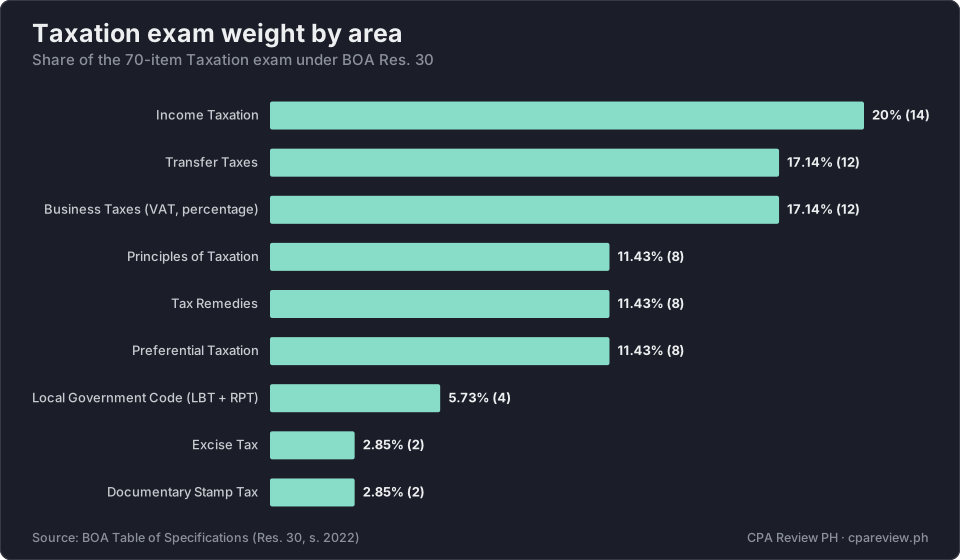
Income taxation is the largest single area at 20%, but no area dominates: transfer taxes and business taxes each come close at 17.14%, and three more areas carry 11.43% apiece. Taxation rewards broad coverage over betting on income tax alone.
Deep Dive: Each Topic Area
1. Income Taxation (20%)
This is the largest and most complex area. You must know the rules for each type of taxpayer and each type of income.
Classification of Taxpayers
| Taxpayer | Tax Base | Rate |
|---|---|---|
| Resident Citizen (RC) | Worldwide income | Graduated rates (0-35%) |
| Non-Resident Citizen (NRC) | Philippine-source income only | Graduated rates (0-35%) |
| Resident Alien (RA) | Philippine-source income only | Graduated rates (0-35%) |
| Non-Resident Alien Engaged in Trade/Business (NRAETB) | Philippine-source income | Graduated rates (0-35%) |
| Non-Resident Alien Not Engaged in Trade/Business (NRANETB) | Philippine-source gross income | 25% final tax |
| Domestic Corporation (DC) | Worldwide income | 25% RCIT (or 20% for SMEs) |
| Resident Foreign Corporation (RFC) | Philippine-source income | 25% RCIT |
| Non-Resident Foreign Corporation (NRFC) | Philippine-source gross income | 25% final tax |
TRAIN Law Individual Tax Table (Effective January 1, 2023 onwards)
| Taxable Income Bracket | Tax Rate |
|---|---|
| Not over P250,000 | 0% |
| Over P250,000 but not over P400,000 | 15% of excess over P250,000 |
| Over P400,000 but not over P800,000 | P22,500 + 20% of excess over P400,000 |
| Over P800,000 but not over P2,000,000 | P102,500 + 25% of excess over P800,000 |
| Over P2,000,000 but not over P8,000,000 | P402,500 + 30% of excess over P2,000,000 |
| Over P8,000,000 | P2,202,500 + 35% of excess over P8,000,000 |
Key Income Tax Concepts
- Gross income — All income from whatever source (compensation, business/profession, passive income, capital gains)
- Exclusions from gross income — Life insurance proceeds, GSIS/SSS/HDMF/PhilHealth contributions, 13th month pay and other benefits (up to P90,000 under TRAIN)
- Deductions — Itemized deductions vs. Optional Standard Deduction (40% of gross sales/receipts for individuals, 40% of gross income for corporations)
- Personal exemptions — Removed by TRAIN Law (replaced by zero-rated bracket up to P250,000)
- Final taxes on passive income — Interest (20%), dividends (10%), royalties (20%), prizes over P10,000 (20%). Note: The CMEPA (RA 12214, 2025) amended select passive income FWT rates — verify current rates in your updated reviewer.
- Capital gains tax — Sale of shares not traded in the stock exchange (15%), sale of real property (6%)
CREATE MORE Act Changes (RA 12066)
The CREATE MORE Act, signed in 2024 and effective 2025, introduced several important changes:
- Corporate income tax remains at 25% (20% for domestic corporations with net taxable income not exceeding P5 million AND total assets not exceeding P100 million)
- Enhanced deductions for research and development expenditures
- Expanded tax incentives administered through the Fiscal Incentives Review Board (FIRB)
- Rationalized incentives — income tax holiday (ITH), special corporate income tax (SCIT) at 5%, enhanced deductions
- Value-Added Tax incentive for registered export enterprises
2. Business Taxes: VAT and Percentage Tax (17.14%)
Value-Added Tax (VAT)
VAT is a 12% tax on the sale, barter, exchange, or lease of goods and properties, and on the sale of services.
Key VAT concepts:
- VAT threshold: P3,000,000 annual gross sales/receipts (entities below this may opt for percentage tax)
- Output VAT: VAT charged on sales
- Input VAT: VAT paid on purchases (creditable against output VAT)
- VAT payable: Output VAT minus Input VAT
- Zero-rated sales: Export sales, sales to PEZA/freeport enterprises, foreign currency denominated sales
- VAT-exempt transactions: Sale of agricultural food products in original state, educational services, health services, residential lease not exceeding P15,000/month
Common exam problem types:
- Computing VAT payable given a series of transactions
- Determining whether a transaction is vatable, zero-rated, or exempt
- Input VAT allocation (for mixed transactions)
Percentage Tax
For entities not VAT-registered (gross sales below P3 million threshold):
- 3% percentage tax on gross sales/receipts (under TRAIN Law, temporarily reduced to 1% during COVID, now back to 3%)
- Special percentage taxes on specific industries (common carriers, international carriers, banks and financial intermediaries, amusement operators)
Excise Tax
Levied on specific goods manufactured or produced in the Philippines. Res 30 scores Excise Tax as its own area, separate from VAT and Percentage Tax — 2.85% of the exam (2 items), not part of this section's 17.14%.
- Alcohol products, tobacco products, petroleum products, automobiles, mineral products, sweetened beverages
- Can be ad valorem (based on value) or specific (based on quantity/volume)
3. Transfer Taxes: Estate Tax and Donor's Tax (17.14%)
Estate Tax (TRAIN Law Changes)
- Rate: Flat 6% on net estate (TRAIN Law simplified this from the previous graduated rates)
- Exemptions/Deductions from gross estate:
- Standard deduction: P5,000,000
- Family home: Up to P10,000,000
- Claims against the estate (validated)
- Unpaid mortgages and indebtedness
- Transfer for public use
- Net share of surviving spouse in conjugal/community property
Computation flow:
- Determine gross estate (all property, real and personal, tangible and intangible)
- Less: Allowable deductions
- Equals: Net estate
- Multiply by 6%
- Equals: Estate tax due
Donor's Tax (TRAIN Law Changes)
- Rate: Flat 6% on total gifts exceeding P250,000 per year
- Exempt donations: Donations to the government, accredited NGOs (subject to limits), dowries/gifts on account of marriage (first P10,000 — note: this exemption was effectively superseded by the P250,000 threshold)
Key concept: Donor's tax is computed on a cumulative basis within the calendar year. Each subsequent donation in the same year adds to the total, and previously paid donor's tax is credited.
4. Local Taxation and Real Property Taxation (5.73%)
Governed by the Local Government Code (RA 7160):
Local Business Tax
- Provinces: Maximum of 1% on gross sales/receipts for the preceding calendar year
- Cities and Municipalities: Rates vary, with cities generally authorized higher rates than municipalities
- Situs of taxation rules: Important for businesses with branches in multiple LGUs
Real Property Tax
- Provinces: Basic rate not exceeding 1% of assessed value
- Cities and Municipalities within Metro Manila: Not exceeding 2%
- Special Education Fund (SEF): Additional 1% of assessed value
- Assessment levels: Vary by property classification (residential, commercial, industrial, agricultural)
Community Tax
- Individuals: Basic P5.00 + P1.00 for every P1,000 of income (max P5,000 additional)
- Corporations: Basic P500 + P2.00 for every P5,000 of assessed value of real property AND gross receipts (max P10,000 additional, per RA 7160 Sec. 159(b))
5. Tax Remedies and Tax Administration (11.43%)
This area tests your knowledge of BIR procedures:
Government Remedies
- Assessment: Preliminary Assessment Notice (PAN) → Final Assessment Notice (FAN) → Final Decision on Disputed Assessment (FDDA)
- Prescriptive periods: 3 years from filing of return (or deadline, whichever is later) to assess; 5 years from assessment to collect
- Exceptions: 10 years for (1) false or fraudulent return with intent to evade tax, or (2) failure to file a return (NIRC Sec. 222(a))
- Distraint and levy: Seizure of personal property (distraint) or real property (levy)
Taxpayer Remedies
- Administrative remedies: Protest to CIR within 30 days from FAN, request for reinvestigation/reconsideration
- Judicial remedies: Appeal to Court of Tax Appeals (CTA) within 30 days from receipt of decision or lapse of 180-day period
- Refund/credit: Filed within 2 years from date of payment or close of taxable quarter (for input VAT)
BIR Rulings and Compliance
- Withholding tax obligations: Expanded withholding tax (EWT), final withholding tax (FWT), creditable withholding tax (CWT)
- Filing deadlines: Quarterly ITR (within 60 days after close of quarter), Annual ITR (April 15), VAT returns (25th day after close of quarter)
6. Preferential Taxation and Tax Incentives (11.43%)
Documentary Stamp Tax (DST)
Imposed on documents, instruments, loan agreements, and papers evidencing the acceptance, assignment, sale, or transfer of obligations. Res 30 scores DST as its own area — 2.85% of the exam (2 items), not part of this section's 11.43%.
- Deed of sale of real property: Based on consideration or fair market value (whichever is higher)
- Shares of stock: Based on par value (or 25% of DST on original issuance for no-par shares)
- Bills of exchange, promissory notes, insurance policies
Preferential Taxation / Tax Incentives
- PEZA incentives: Income tax holiday, 5% special tax on gross income earned
- CREATE MORE enhancements: Rationalized incentive packages through FIRB
- Special economic zones: Various incentive packages
- BOI-registered enterprises: Enhanced deductions, duty-free importation
7. Principles of Taxation (11.43%)
This area is the theoretical foundation of the subject and, at 11.43% of the exam (8 items), is too heavy to skip in favor of computation-heavy topics.
- Inherent powers of the State: taxation, police power, and eminent domain — how they differ in purpose, authority, and compensation, and why police power is regarded as the most pervasive and least limitable of the three
- Constitutional and inherent limitations on the power of taxation (e.g., due process, equal protection, uniformity, non-impairment, and the inherent limits of public purpose, territoriality, and non-delegability)
- Situs of taxation — the rules for determining where a tax may validly be imposed
- Double taxation — its kinds and the available remedies
- Escapes from taxation — tax evasion vs. tax avoidance, tax exemption, and tax amnesty/condonation
Keep up with the latest tax rules.
Practice Taxation questions covering current law, with AI explanations. Seven days free, no card.
Study Strategy for Taxation
The Layered Approach
Taxation is best studied in layers. Do not try to memorize everything at once.
Layer 1 — Framework (Week 1-2): Learn the structure of the NIRC. Understand the flow: Who is the taxpayer? What is the tax base? What is the rate? When is it due?
Layer 2 — Core Rules (Week 3-5): Master income tax (individuals and corporations), VAT, estate tax, and donor's tax. These cover roughly 54% of the exam.
Layer 3 — Special Rules (Week 6-7): Study local taxes, tax remedies, DST, and tax incentives. These are less computational but require memorization of specific rules and thresholds.
Layer 4 — Integration (Week 8): Take full mock exams. Practice switching between topic areas quickly.
Memorization Techniques
Tax Rate Cards
Create index cards for each tax type:
- Front: Tax type and taxpayer
- Back: Rate, base, deadline, key exemptions
Review these cards during idle time — commuting, waiting in line, before bed.
The NIRC Structure Mnemonic
Organize your knowledge by NIRC Title:
- Title I: Organization and function of BIR
- Title II: Income tax (the biggest chunk)
- Title III: Estate and donor's tax
- Title IV: VAT
- Title V: Other percentage taxes
- Title VI: Excise tax
- Title VII: DST
- Title VIII: Remedies
- Title IX-XIII: Other provisions
Knowing where each topic falls in the code helps you connect related concepts.
Track Legislative Changes
The most dangerous trap in Taxation is studying outdated rules. Make sure your materials reflect:
- TRAIN Law (RA 10963, 2018): New individual tax table, flat 6% estate/donor's tax, new excise taxes, removal of personal exemptions
- CREATE Act (RA 11534, 2021): Reduced corporate tax to 25%/20%, MCIT temporarily reduced to 1% (expired June 30, 2023; now back to 2%), rationalized incentives
- CREATE MORE Act (RA 12066, 2024): Enhanced R&D deductions, expanded incentive packages, VAT incentives for exporters
- CMEPA (RA 12214, 2025): Amended passive income final withholding tax rates and related provisions
- Ease of Paying Taxes Act (RA 11976, 2024): Simplified classification of taxpayers, updated filing procedures
Common Pitfalls
1. Confusing Final Tax with Creditable Tax
Final withholding tax is the full and final tax on the income — the taxpayer no longer reports it in the ITR. Creditable withholding tax is an advance payment that is deducted from tax due in the ITR. Mixing these up leads to wrong computations.
2. Applying the Wrong Tax Table
Some reviewees still use the old graduated tax table (before TRAIN). The exam will use the current rates. Double-check which table your reviewer uses.
3. Forgetting Situs Rules
For non-resident aliens and foreign corporations, only Philippine-source income is taxable. For resident citizens, worldwide income is taxable. Situs rules also matter for estate tax (e.g., intangible personal property of NRA decedent with reciprocity).
4. Ignoring Procedural Questions
Tax remedies may seem boring, but 11.43% of the exam (8 items) is a lot. Know the prescriptive periods, protest procedures, and CTA jurisdiction. These are usually straightforward once memorized.
5. Not Reading the Problem Carefully
Tax problems often hinge on a single word: "gross" vs. "net," "resident" vs. "non-resident," "engaged in trade or business" vs. "not engaged." Read every problem twice.
Exam Day Strategy
Before the Exam
Review your tax rate cards one final time. Focus on the TRAIN Law individual tax table, the 6% estate/donor's tax rules, and VAT threshold amounts.
During the Exam
- Start with what you know — Answer conceptual questions and simple computations first
- Flag complex computations — Multi-step income tax problems can eat time; come back to them
- Watch for TRAIN Law traps — If a question uses old rules (like graduated estate tax rates), the answer choices may include both old and new rates. Always apply current law unless the question specifically states otherwise.
- Check your units — Are they asking for tax due or tax payable (after credits)? Gross income or taxable income?
Time Management
With 70 questions in 180 minutes, you have about 2.6 minutes per question. Conceptual questions (tax remedies, taxpayer classification) should take under a minute. Use the saved time for complex income tax computations.
How CPA Review PH Can Help
CPA Review PH's AI-powered platform is particularly useful for Taxation because:
- Updated content: Our question bank reflects TRAIN Law, CREATE Act, CREATE MORE Act, and CMEPA provisions
- Adaptive practice: The AI identifies which tax topics you struggle with and generates targeted practice problems
- Instant explanations: Get step-by-step solutions showing the applicable tax rule, rate, and computation
- Mock exams: Simulate the 70-MCQ, 4-hour format with questions matching the BOA Table of Specifications
Final Thoughts
Taxation is a subject that rewards discipline and repetition. The rules are numerous but logical — the NIRC has an internal structure that, once understood, makes individual provisions easier to remember. Focus your energy on income tax and business tax (37% of the exam), do not neglect transfer taxes and tax remedies, and always study from updated materials.
The TRAIN Law, CREATE MORE Act, and CMEPA have changed the landscape significantly. Make sure every formula, rate, and threshold you memorize reflects current law.
You have the structure. You have the strategy. Now put in the hours.
Good luck, future CPA.