If you are preparing for the 2026 CPALE, there is a tax law development you cannot afford to ignore: the CREATE MORE Act (RA 12066), signed into law on November 8, 2024. This law amends the earlier CREATE Act and introduces significant changes to corporate taxation, incentive regimes, and withholding tax rules — all of which are fair game for the Taxation subject on the CPA board exam.
While most reviewers still focus heavily on the TRAIN Law (RA 10963) — and rightly so, since it governs individual income tax, VAT, and excise taxes — the CREATE MORE Act is where the new and unfamiliar exam questions will come from in 2026. The BOA consistently tests recent legislative changes, and CREATE MORE is the most significant tax legislation since TRAIN.
What Is the CREATE MORE Act?
The Corporate Recovery and Tax Incentives for Enterprises to Maximize Opportunities for Reinvigorating the Economy (CREATE MORE) Act is the enhanced version of the original CREATE Act (RA 11534, signed March 2021). It builds on CREATE's corporate tax rate reduction and overhauls the tax incentive framework.
Here are the key provisions that CPA candidates need to study.
1. Corporate Income Tax Rate: Locked at 25%
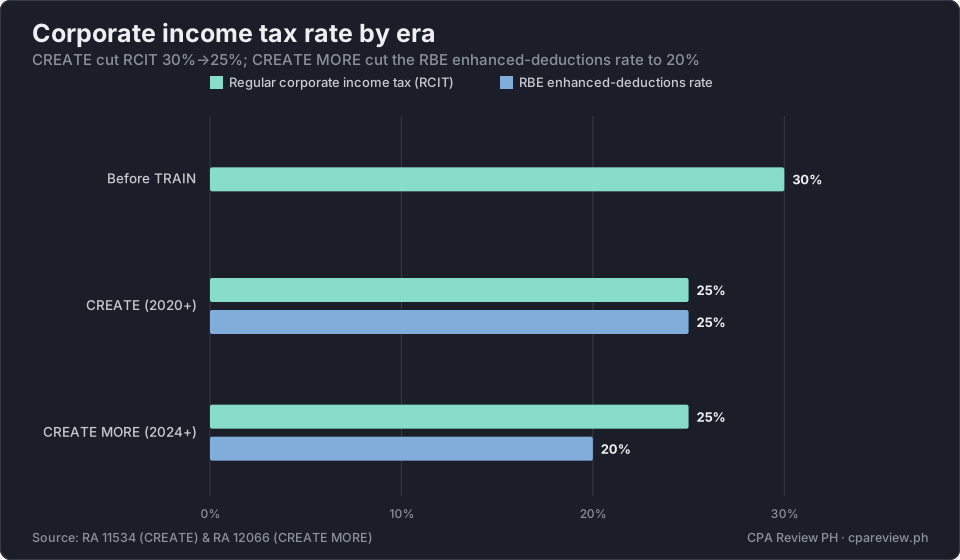
The CREATE Act reduced the regular corporate income tax (RCIT) rate from 30% to 25% effective July 1, 2020. The CREATE MORE Act retains this 25% rate and makes it permanent.
For the exam, remember:
- Regular corporate income tax: 25% of taxable income
- Minimum corporate income tax (MCIT): 2% of gross income
- The CREATE Act temporarily reduced MCIT from 2% to 1% as a COVID-relief measure (July 1, 2020 to June 30, 2023), but this has reverted to 2% since July 1, 2023
- MCIT applies starting the 4th taxable year of operations
- A corporation pays whichever is higher — RCIT or MCIT
- Excess MCIT over RCIT can be carried forward and credited against RCIT for the next 3 succeeding taxable years
Exam trap: The MCIT rate is currently 2%, not 1%. The 1% rate was a temporary COVID-era measure under CREATE that expired on June 30, 2023. If an exam question mentions the "current" MCIT rate, the answer is 2%.
2. Enhanced Tax Incentives for Registered Business Enterprises
This is where CREATE MORE makes its biggest mark. The law significantly expands tax incentive packages for businesses registered with Investment Promotion Agencies (IPAs) like PEZA, BOI, and the Bases Conversion and Development Authority.
Income Tax Holiday (ITH)
Registered Business Enterprises (RBEs) can enjoy an Income Tax Holiday of 4 to 7 years, depending on location and industry priority:
| Category | ITH Duration |
|---|---|
| Domestic enterprises in priority industries | 4–7 years |
| Export enterprises (≥70% export) | 4–7 years |
| Projects in areas recovering from disaster/conflict | Up to 7 years |
Special Corporate Income Tax (SCIT)
Export enterprises (those with 70%+ export sales) may avail of a Special Corporate Income Tax of 5% on gross income earned — significantly lower than the regular 25% RCIT. SCIT is not available to domestic market enterprises (DMEs) — they must use the Enhanced Deductions Regime instead.
CREATE MORE changed the sequencing — a classic old-answer trap. Under CREATE, SCIT was only available after the ITH period. Under CREATE MORE, a registered export enterprise chooses one of three routes: (1) ITH, followed by SCIT or EDR; (2) SCIT immediately at the start of commercial operations; or (3) EDR immediately at the start of commercial operations. If an item asks whether an export enterprise must first complete an ITH before electing SCIT, the answer under current law is no.
Key change from CREATE to CREATE MORE: The enhanced deductions (ED) regime — the alternative to SCIT — has been strengthened. RBEs under EDR now pay a reduced 20% corporate income tax rate on taxable income from registered projects (down from the regular 25% RCIT). This is one of CREATE MORE's most significant provisions.
Duty Exemption on Capital Equipment
CREATE MORE expands the duty-free importation of capital equipment, raw materials, and spare parts for registered enterprises.
For the exam: Understand the general framework — an export enterprise may take ITH first and then SCIT or EDR, or go straight to SCIT (5% on gross income) or EDR (20% CIT on taxable income) from the start of commercial operations. A domestic market enterprise may take ITH then EDR, or EDR from the start. Under CREATE MORE it does not get SCIT at all, which is a narrowing worth noting: under the original CREATE, a domestic market enterprise whose activity was classified as "critical" under the SIPP could elect SCIT. A fact pattern set before CREATE MORE may still turn on that. Know which type of enterprise qualifies for which regime.
3. Withholding Tax on Dividends and Interest
Dividends
The CREATE MORE Act introduces important changes to dividend taxation that candidates frequently confuse:
Domestic Corporation to Individual Shareholders:
- Final tax of 10% on dividends (this rate was set by TRAIN Law and remains unchanged)
Foreign Corporation Dividends:
- Dividends received by a domestic corporation from a foreign corporation are generally subject to regular income tax
- However, dividends from a foreign corporation to a domestic corporation may be exempt under specific conditions: at least 20% ownership, 2-year holding period, and reinvestment in the Philippines (per NIRC Sec. 27(D)(4) as amended)
Inter-corporate Dividends (Domestic):
- Dividends received by a domestic corporation from another domestic corporation are not subject to income tax (to avoid double taxation)
Exam trap: Do not confuse the 10% final tax on individual shareholders with inter-corporate dividend exemptions. The exam frequently tests whether you can identify the correct tax treatment based on the type of recipient (individual vs corporate, domestic vs foreign).
Interest Income
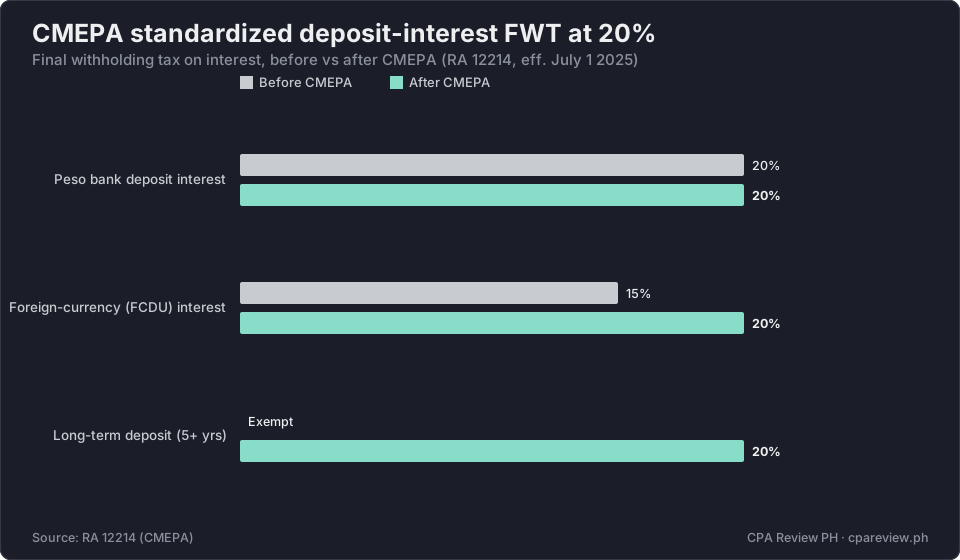
- Interest on peso bank deposits: 20% final withholding tax
- Interest on foreign currency deposits (FCDU): 20% final withholding tax (updated by CMEPA — see note below)
- Interest on long-term deposits/investments (5+ years): no longer exempt (removed by CMEPA — see note below)
- Pre-termination of long-term deposits follows a graduated rate based on holding period
CMEPA Update (RA 12214, effective July 1, 2025): The Capital Markets Efficiency Promotion Act standardized the final withholding tax on all bank deposit interest to a uniform 20%, regardless of currency. The previous 15% FCDU rate and the tax exemption on long-term deposits (5+ years) were both removed. From the May 2026 sitting onward, including the October 2026 CPALE, all deposit interest is subject to 20% FWT.
These rates reflect the latest amendments through CMEPA. CREATE MORE clarifies the treatment for registered enterprises with special tax incentive packages.
Keep up with the latest tax rules.
Practice Taxation questions covering current law, with AI explanations. Seven days free, no card.
4. Value-Added Tax (VAT) Incentives for RBEs
One of CREATE MORE's most significant additions is the VAT incentive framework for registered enterprises:
- VAT zero-rating on local purchases of goods and services by export-oriented RBEs
- VAT exemption on importation of capital equipment, raw materials, and spare parts by RBEs during the ITH period
For the exam: The key distinction is between VAT-exempt (no output VAT, no input VAT credit) and VAT zero-rated (0% output VAT, but input VAT is creditable). This conceptual difference is a perennial exam favorite.
5. Enhanced Deductions Regime
As an alternative to the SCIT, qualifying RBEs may opt for enhanced deductions on top of the regular allowable deductions under the Tax Code:
- Additional deduction on labor expense: 50% of direct labor costs (for the duration of the Enhanced Deductions period)
- Additional deduction for research and development: 100% of R&D expenses
- Additional depreciation allowance on buildings and fixed assets
- Deduction on power cost: 50% of power expense (for enterprises in less developed areas)
For the exam: Expect conceptual questions about when an RBE would choose SCIT vs EDR. Key distinction: SCIT (5% on gross income, available only to export enterprises) is simpler but does not allow additional deductions. EDR (20% on taxable income with additional deductions) is more complex but potentially results in lower tax for enterprises with high deductible expenses. Domestic market enterprises can only use EDR.
6. Tax Provisions You Must Compare: TRAIN vs CREATE vs CREATE MORE
The Taxation exam often presents questions that test your knowledge of which law changed what. Here is a side-by-side comparison of the most testable provisions:
| Provision | Before TRAIN | TRAIN (2018+) | CREATE (2020+) | CREATE MORE (2024+) |
|---|---|---|---|---|
| Individual income tax (top rate) | 32% | 35% (over ₱8M) | No change | No change |
| Corporate income tax | 30% | No change | 25% | 25% (confirmed) |
| MCIT rate | 2% | No change | 1% (temporary, expired June 2023) | 2% (reverted) |
| VAT registration threshold | ₱1,919,500 | ₱3,000,000 | No change | No change |
| Estate tax | Graduated (5-20%) | 6% flat | No change | No change |
| Donor's tax | Graduated (2-15%) | 6% flat | No change | No change |
| SCIT for export RBEs | N/A | N/A | 5% | 5% (export enterprises only) |
| EDR CIT rate | N/A | N/A | 25% (regular) | 20% (reduced for RBEs) |
Exam strategy: If a question asks about corporate income tax rates or incentive regimes, think CREATE/CREATE MORE. If it asks about individual income tax, VAT thresholds, estate tax, or donor's tax, think TRAIN.
How to Study CREATE MORE for the CPALE
1. Do Not Ignore the TRAIN Law
CREATE MORE does not replace TRAIN. Both laws amend different parts of the National Internal Revenue Code (NIRC). Your Taxation review must cover both:
- TRAIN Law → individual income tax, VAT, excise tax, estate tax, donor's tax
- CREATE MORE → corporate income tax, tax incentives, RBE framework
2. Focus on the "What Changed" Questions
The exam loves to test transitions. Practice questions like:
- "Under current law, what is the MCIT rate?" (Answer: 2% — the temporary 1% rate under CREATE expired June 30, 2023)
- "When does MCIT apply?" (Answer: 4th taxable year of operations)
- "What is the SCIT rate for registered business enterprises?" (Answer: 5% on gross income)
3. Understand the Incentive Framework Conceptually
You do not need to memorize every incentive tier for every IPA. Instead, understand the general flow: Registration → ITH period (4-7 years) → SCIT or Enhanced Deductions → Sunset.
4. Review the Withholding Tax Tables
Dividends, interest, royalties, and other passive income — know the final withholding tax rates cold. These are computation questions where you either know the rate or you do not.
Practice With Updated Questions
One challenge with studying new tax legislation is that many traditional reviewer materials have not yet been updated to reflect CREATE MORE provisions. If your reviewer still references the 30% corporate tax rate or the temporary 1% MCIT rate, it is outdated.
On cpareview.ph, Taxation practice questions are regularly updated to reflect the latest tax laws, including CREATE MORE Act provisions. The AI tutor can explain the relationship between TRAIN, CREATE, and CREATE MORE — helping you understand not just the current rates, but why they changed and how the exam tests those changes.
Try the free 7-day trial to access updated Taxation review materials across all tax topics.
Key Takeaway
The CREATE MORE Act is not just another tax law amendment — it is the most significant corporate tax reform since the TRAIN Law. For the 2026 CPALE, expect questions that test your understanding of the 25% RCIT, the current 2% MCIT, the SCIT incentive regime, and the VAT framework for registered enterprises. Master these provisions alongside your TRAIN Law fundamentals, and you will be well-prepared for whatever the BOA puts on the Taxation exam.