AFAR (Advanced Financial Accounting and Reporting) is 70 of the 450 multiple-choice questions on the CPALE — sat on Day 3 (October 26, 2026), afternoon session, right after FAR in the morning. Every one of those 70 questions is drawn from the same official blueprint: BOA Resolution No. 30, Series of 2022, the Table of Specifications that has governed the CPALE since October 2022 and continues to govern both the May and October 2026 sittings.
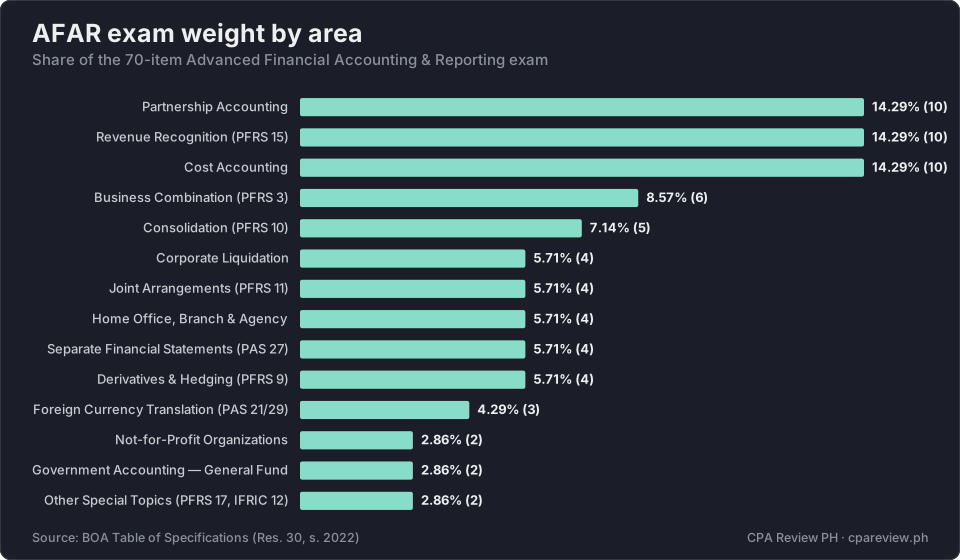
That blueprint splits AFAR into fourteen areas, each with an exact percentage weight — and because AFAR always has exactly 70 items, that percentage converts cleanly into a question count. What follows is the Board's own weighting, area by area, not a review center's rough syllabus breakdown.
Table of Specifications
| Area | Weight | MCQs (of 70) |
|---|---|---|
| Partnership Accounting | 14.29% | 10 |
| Revenue Recognition (PFRS 15) | 14.29% | 10 |
| Cost Accounting | 14.29% | 10 |
| Business Combination (PFRS 3) | 8.57% | 6 |
| Consolidation (PFRS 10) | 7.14% | 5 |
| Corporate Liquidation | 5.71% | 4 |
| Joint Arrangements (PFRS 11) | 5.71% | 4 |
| Home Office, Branch & Agency | 5.71% | 4 |
| Separate Financial Statements (PAS 27) | 5.71% | 4 |
| Derivatives & Hedging (PFRS 9) | 5.71% | 4 |
| Foreign Currency Translation (PAS 21/29) | 4.29% | 3 |
| Not-for-Profit Organizations | 2.86% | 2 |
| Government Accounting — General Fund | 2.86% | 2 |
| Other Special Topics (PFRS 17, IFRIC 12) | 2.86% | 2 |
| Total | 100% | 70 |
Source: BOA Table of Specifications (Res. 30, s. 2022). Governs both the May and October 2026 sittings.
Drill AFAR until it clicks.
Practice AFAR questions with step-by-step AI explanations. Seven days free, no card.
What Each Area Actually Covers
Partnership Accounting — 10 of 70 questions (14.29%)
One of three areas tied for AFAR's heaviest weight. The nature, scope, and objectives of partnership accounting as distinguished from single-proprietorship and corporation accounting; formation and the initial capital contribution of the partners; operations, dissolution, and changes in ownership — admission of a new partner by purchase of interest or by investment, and withdrawal, retirement, or death of a partner, plus incorporation of a partnership; and liquidation of a partnership under the lump-sum method and the installment method.
Revenue Recognition (PFRS 15) — 10 of 70 questions (14.29%)
Tied for AFAR's heaviest weight. The five-step model for revenue from contracts with customers, and the issues that make it testable in practice: right of return, principal-agent relationships, non-refundable upfront fees, licensing and royalties, repurchase arrangements, gift cards, consignment arrangements, and bill-and-hold arrangements. Long-term construction contracts get their own sub-item — revenue recognized over time using the input method or the output method, and the resulting contract asset or contract liability — as does accounting for franchise operations from the franchisor's point of view (the initial franchise fee and the continuing franchise fee) and accounting for consignment sales specifically (amount remitted, ending inventory valuation, determination of net income).
Cost Accounting — 10 of 70 questions (14.29%)
The third area tied for AFAR's heaviest weight. Systems of cost accumulation — actual, normal, and standard costing; job-order costing, including accounting for scrap, waste, spoilage, and rework; process costing under the FIFO and average methods, including accounting for normal and abnormal lost units; backflush costing for JIT systems; activity-based costing, including allocation of costs and determination of cost pool rates versus traditional costing; accounting for joint and by-products under the market (sales) value method, including the split-off-point, hypothetical market value, average unit, and weighted average approaches; and service cost allocation under the direct, step-down, and reciprocal methods.
Business Combination (PFRS 3) — 6 of 70 questions (8.57%)
The nature, scope, and characteristics of a business combination; the acquisition method for a statutory merger, consolidation, or acquisition of assets and liabilities; determining the consideration transferred; recognizing the acquired assets and liabilities; and recognizing and measuring goodwill or a gain from a bargain purchase.
Consolidation (PFRS 10) — 5 of 70 questions (7.14%)
Consolidation procedures and the amounts to be presented in the consolidated financial statements: net income, dividends, amortization, and impairment of goodwill; intercompany transactions involving inventories, land, and depreciable assets; and the split of net income, other comprehensive income, equity, retained earnings, and dividends between the equity holders of the parent and non-controlling interest.
Corporate Liquidation — 4 of 70 questions (5.71%)
Preparing the Statement of Affairs, the Statement of Deficiency, and the Statement of Realization and Liquidation, and determining the order of priority of claimants to the assets of a corporation subject to liquidation.
Joint Arrangements (PFRS 11) — 4 of 70 questions (5.71%)
Joint operations and joint ventures, the latter accounted for under the equity method — and, repeatedly, the exam's own angle on this area: differentiating both from a business combination.
Home Office, Branch & Agency — 4 of 70 questions (5.71%)
Transactions on the books of the home office and the branch, under both the general procedure and the special procedure for inter-branch transfer of cash and merchandise at billed price; reconciliation of reciprocal accounts; preparation of individual and combined financial statements; and accounting for agency transactions.
Separate Financial Statements (PAS 27) — 4 of 70 questions (5.71%)
Accounting for investments in subsidiaries, associates, and joint ventures at cost, or applying financial-instrument accounting to the investment instead — the syllabus's own sub-items list this alternative as PAS 39 (Financial Instruments: Recognition and Measurement) and as PFRS 9, side by side, reflecting the resolution's original 2022 wording even though PFRS 9 has since superseded PAS 39 as the standard in force — plus the treatment of dividends and their related disclosures.
Derivatives & Hedging (PFRS 9) — 4 of 70 questions (5.71%)
Recognition and de-recognition of derivatives — forwards, futures, options, and swaps — and hedging activities from the investor's point of view: undesignated hedges of an exposed asset or liability position, fair value hedges and cash flow hedges of a firm commitment or a forecasted transaction, and hedges of a net investment in a foreign entity.
Foreign Currency Translation (PAS 21/29) — 3 of 70 questions (4.29%)
Translating from the functional currency into the presentation currency under the closing/current rate method, translating into the functional currency (remeasurement), and restating financial statements denominated in the functional currency of a hyperinflationary economy.
Not-for-Profit Organizations — 2 of 70 questions (2.86%)
The nature of business transactions and financial reporting for voluntary health and welfare organizations, hospitals and other health care organizations, colleges and universities, and other not-for-profit organizations such as churches, museums, fraternities, and associations.
Government Accounting — General Fund — 2 of 70 questions (2.86%)
Basic concepts in government accounting, the procedures in government budgeting, the accounting policies under the Government Accounting Manual (GAM), and journal entries in the books of a National Government Agency.
Other Special Topics (PFRS 17, IFRIC 12) — 2 of 70 questions (2.86%)
The smallest-weighted area, but two named standards: accounting for insurance contracts by insurers under PFRS 17 — the different types of insurance contracts, changes in accounting policies, and recognition and measurement of insurance and reinsurance contracts — and accounting for build-operate-transfer service concession arrangements under IFRIC 12, which turns on whether the operator's right is a financial asset or an intangible asset.
Where the Marginal Question Is
Partnership Accounting, Revenue Recognition, and Cost Accounting are tied for AFAR's heaviest weight — 10 questions each, 30 of the 70 total, before any other area is counted. Add Business Combination's 6 and the top four areas already account for 36 of 70 — just over half the paper. The remaining ten areas split the other 34 questions into progressively narrower slices, down to 2 questions each for the three lightest areas.
AFAR on the October 2026 CPALE
AFAR sits on Day 3 (October 26, 2026), the afternoon session, right after FAR — 70 MCQs, the same allocation as every subject except RFBT. Filing for the October 2026 CPALE opened July 10, 2026 and closes September 9, 2026, per PRC's 2026 Schedule of Examinations.
If you already sat AFAR in May 2026 and are retaking it in October, the coverage itself does not change: BOA Resolution No. 30, Series of 2022 governs both the May and October 2026 sittings, so the table above is the same table you were tested against the first time — area for area, item for item.
Related
- All six subjects: CPALE Coverage per Subject: Table of Specifications 2026 — the same Table of Specifications data for FAR, MAS, Auditing, Taxation, and RFBT, side by side.
- How to study it: How to Pass AFAR in the CPA Board Exam: Complete Guide — this page tells you what is covered and how much each area is worth; that guide tells you how to actually study it.