RFBT (Regulatory Framework for Business Transactions) is 100 of the 450 multiple-choice questions on the CPALE — the only subject examined at 100 items instead of 70 — sat on Day 2 (October 25, 2026), afternoon session, right after Taxation. Every one of those 100 questions is drawn from the same official blueprint: BOA Resolution No. 30, Series of 2022, the Table of Specifications that has governed the CPALE since October 2022 and continues to govern both the May and October 2026 sittings.
The resolution groups RFBT into eight lettered top-level areas (A through H), but two of those — Law on Business Organization (44 items) and Law on Other Business Transactions (25 items) — are themselves umbrella groupings of several distinct laws. The table below uses the resolution's own 23 second-level rows instead, so each row is a single, study-able law or topic rather than a lettered grouping that bundles several together.
Table of Specifications
| Area | Weight | MCQs (of 100) |
|---|---|---|
| Obligations | 6% | 6 |
| Contracts | 6% | 6 |
| Sales | 3% | 3 |
| Credit Transactions | 3% | 3 |
| Partnerships | 6% | 6 |
| Corporations | 30% | 30 |
| Insurance | 3% | 3 |
| Cooperatives | 5% | 5 |
| Financial Rehabilitation and Insolvency | 5% | 5 |
| Bouncing Checks (BP 22) | 2% | 2 |
| Consumer Protection | 2% | 2 |
| Philippine Competition Act | 2% | 2 |
| Government Procurement Law | 2% | 2 |
| PDIC Law | 2% | 2 |
| Secrecy of Bank Deposits | 2% | 2 |
| Truth in Lending Act | 2% | 2 |
| Anti-Money Laundering Act (AMLA) | 6% | 6 |
| Intellectual Property Law | 2% | 2 |
| Data Privacy Act | 3% | 3 |
| Electronic Commerce Act | 2% | 2 |
| Ease of Doing Business Act | 2% | 2 |
| Labor Law | 2% | 2 |
| Social Security Law | 2% | 2 |
| Total | 100% | 100 |
Source: BOA Table of Specifications (Res. 30, s. 2022). Governs both the May and October 2026 sittings.
Lock in RFBT law and regulation.
Practice RFBT questions with AI explanations. Seven days free, no card.
What Each Area Actually Covers
Obligations — 6 of 100 questions (6%)
Part of Law on Business Transactions, governed by the Civil Code of the Philippines (RA 386). The sources of obligations — law, contracts, quasi-contracts, delicts, and quasi-delicts; the kinds of obligations — pure, conditional, or with a term; solidary or joint; alternative or facultative; divisible or indivisible; and obligations with a penal clause; the specific circumstances affecting obligations, including fortuitous events, fraud, negligence, delay, and breach of contract; and the modes of extinguishment — payment, dation in payment, application of payments, payment by cession, tender of payment and consignation, and loss of the thing due, remission, confusion, compensation, and novation.
Contracts — 6 of 100 questions (6%)
Also under Law on Business Transactions and the Civil Code of the Philippines (RA 386). The general provisions of contracts — definition, classification, stages, freedom to contract, and persons bound; the essential requisites — consent, object, and cause; the forms of contracts; reformation and interpretation of contracts; and defective contracts — rescissible, voidable, unenforceable, and void or inexistent.
Sales — 3 of 100 questions (3%)
Governed principally by the Civil Code of the Philippines (RA 386). The nature, forms, and requisites of a contract of sale; earnest money as distinguished from option money; the rights and obligations of vendor and vendee; express and implied warranties; installment sales under the Recto Law (Civil Code Arts. 1484–1486) (personal property), the Maceda Law (RA 6552) (real property), and PD 957 and the Condominium Act (RA 4726); and the extinguishment of a contract of sale through conventional or legal redemption.
Credit Transactions — 3 of 100 questions (3%)
Governed principally by the Civil Code of the Philippines (RA 386). Pledge, real mortgage, and chattel mortgage — their similarities, requisites, indivisibility, the pactum commissorium prohibition, and the position of third-party pledgors and mortgagors; the requirements to bind the parties and third persons; and the obligations and rights of pledgor and pledgee, and of mortgagor and mortgagee.
Partnerships — 6 of 100 questions (6%)
Part of Law on Business Organization, governed by the Civil Code of the Philippines (RA 386). The nature of a partnership as distinguished from a corporation, the kinds of partnerships, the formalities required to form one, the rules of management, the obligations of partners — to the partnership, to each other, and to third persons — the rights of a partner, the sharing of profits and losses, dissolution and winding up, and limited partnerships.
Corporations — 30 of 100 questions (30%)
The single largest row anywhere in RFBT — under the syllabus's own Law on Business Organization heading, this one topic alone is 30% of the entire subject, governed by the Revised Corporation Code (RA 11232). The definition and classes of corporations; nationality, including the control test and the grandfather rule; corporate juridical personality, including the doctrine of separate juridical personality and the doctrine of piercing the corporate veil; capital structure — the number and qualifications of incorporators, subscription requirements, corporate term, and the classification of shares, from preferred versus common to founder's, redeemable, and treasury shares; incorporation and organization, including the Articles of Incorporation and the adoption of by-laws; corporate powers, including the power to extend or shorten the corporate term, to increase or decrease capital stock, to deny pre-emptive rights, and the doctrine of ultra vires acts; the rights of stockholders and members — voting, appraisal, inspection, pre-emptive, and dividend rights, and individual, representative, and derivative suits; the board of directors and trustees, including tenure, election, removal, the business judgment rule, and personal liability; capital affairs, including certificates of stock, watered stocks, and the alienation of shares; the modes of dissolution and methods of liquidation; other corporate forms — non-stock, educational, religious, One Person Corporations, and foreign corporations; merger and consolidation; investigations, offenses, and penalties, including the authority of the Securities and Exchange Commission; corporate governance for publicly-listed companies and public companies and registered issuers; securities, including the prohibition on fraud, manipulation, and insider trading; and the general financial reporting requirements under the Securities Regulation Code (RA 8799), SRC Rule 68.
Insurance — 3 of 100 questions (3%)
Governed by The Insurance Code, as amended by RA 10607. The concept and elements of an insurance contract, its characteristics and nature, the classes of insurance, variable contracts, insurable interest, the perfection and rescission of the contract of insurance, and claims settlement and subrogation.
Cooperatives — 5 of 100 questions (5%)
Governed by the Philippine Cooperative Code of 2008 (RA 9520). The organization and registration of cooperatives, their administration, the responsibilities, rights, and privileges of cooperatives, membership, capital and property of funds, the audit, inquiry, and members' right to examine, the allocation and distribution of funds, the types and categories of cooperatives, and their merger, consolidation, and dissolution.
Financial Rehabilitation and Insolvency — 5 of 100 questions (5%)
Its own lettered area of the resolution (Area D), governed by the Financial Rehabilitation and Insolvency Act (FRIA, RA 10142). Suspension of payments; rehabilitation — its types, the commencement order, the stay or suspension order, the rehabilitation receiver, the management committee, the rehabilitation plan, and the cram-down effect; and liquidation — its types, the conversion of rehabilitation to liquidation proceedings, the liquidation order, the rights of secured creditors, the liquidator, the determination of claims, and the liquidation plan.
Bouncing Checks (BP 22) — 2 of 100 questions (2%)
The requisites to be held liable under Batas Pambansa Blg. 22 — issuing a check without sufficient funds, evidence of knowledge of insufficient funds, the duty of the drawer, and how credit is construed — and how liability under BP 22 compares with estafa under Article 315(2)(d).
Consumer Protection — 2 of 100 questions (2%)
Consumer product quality and safety, deceptive sales acts and practices, product service and warranty, and labelling and packaging under the Consumer Act (RA 7394), and consumer rights under the Price Tag Act and the Lemon Law (RA 10642).
Philippine Competition Act — 2 of 100 questions (2%)
Governed by the Philippine Competition Act (RA 10667). The definition and scope of application; prohibited acts — anti-competitive agreements, abuse of dominant position, and prohibited mergers and acquisitions; and covered transactions, including the thresholds for compulsory notification, the notifying entity, and the period of notification.
Government Procurement Law — 2 of 100 questions (2%)
Governed by the New Government Procurement Act (RA 12009), whose implementing rules and regulations took effect February 25, 2025 and which expressly repealed the former Government Procurement Reform Act (RA 9184) — RA 9184 still governs procurements published before that date, but RA 12009 is the law in force for the October 2026 CPALE. General principles, scope and application, the procurement procedures from the preparation of bidding documents through award, implementation, and termination of the contract, disclosure of relations, and alternative methods of procurement.
PDIC Law — 2 of 100 questions (2%)
Part of Law on Other Business Transactions, governed by the PDIC Charter (RA 3591, as amended). Insurable deposits, the maximum liability, and the requirements for claims.
Secrecy of Bank Deposits — 2 of 100 questions (2%)
Governed by the Bank Secrecy Law (RA 1405). The purpose of the law, prohibited acts, the deposits covered, the exceptions, and garnishment of deposits including foreign deposits.
Truth in Lending Act — 2 of 100 questions (2%)
Governed by the Truth in Lending Act (RA 3765). The purpose of the law, the obligation of creditors to persons to whom credit is extended, covered and excluded transactions, and the consequences of non-compliance with the disclosure obligation.
Anti-Money Laundering Act (AMLA) — 6 of 100 questions (6%)
The heaviest single row under Law on Other Business Transactions, governed by the Anti-Money Laundering Act (RA 9160, as amended). Its purpose, policies, and principles; unlawful activities; covered persons; money laundering, terrorism financing, and asset forfeiture; preventive measures — prohibited accounts and customer due diligence; beneficial ownership; record-keeping requirements; and the safe harbor provision.
Intellectual Property Law — 2 of 100 questions (2%)
Governed by the Intellectual Property Code (RA 8293), as amended. Patents, trademarks, service marks and trade names, and copyright.
Data Privacy Act — 3 of 100 questions (3%)
Governed by the Data Privacy Act (RA 10173). The scope of application, the data privacy principles, the processing of personal data, security measures for protecting personal data, the rights of the data subject, data breach notification, outsourcing and subcontracting agreements, and registration and compliance requirements.
Electronic Commerce Act — 2 of 100 questions (2%)
Governed by the Electronic Commerce Act (RA 8792). Its principles, application, and definition of terms; the legal recognition and communication of electronic data messages and electronic documents; electronic commerce in the carriage of goods; and electronic transactions in government.
Ease of Doing Business Act — 2 of 100 questions (2%)
The Ease of Doing Business and Efficient Delivery of Government Service Delivery Act (RA 11032), in full, which expanded the earlier RA 9485: its policy, construction, and interpretation; coverage and scope; the reengineering of systems and procedures; the Citizen's Charter; accessing government services; streamlined procedures for the issuance of permits and licenses; and violations, jurisdiction, penalties, and immunity.
Labor Law — 2 of 100 questions (2%)
Labor standards under the Labor Code (PD 442, as amended) — basic pay, overtime premium, night shift differential, holiday premium, 13th month pay, and leaves, including service incentive leave, maternity leave under the 105-Day Expanded Maternity Leave Law (RA 11210), paternity leave under the Paternity Leave Act (RA 8187), and parental leave for solo parents under the Solo Parents' Welfare Act (RA 8972, as amended by RA 11861, the Expanded Solo Parents Welfare Act).
Social Security Law — 2 of 100 questions (2%)
Governed by the Social Security Act of 2018 (RA 11199). The scope and coverage of the law, pension, retirement, and other benefits, exemptions from tax, legal process, and lien, employee and employer contributions, contributions from self-employed members, and the remittance of contributions.
Where the Marginal Question Is
Corporations alone is 30 of the 100 RFBT questions — under the syllabus's own Law on Business Organization heading, this single topic is close to a third of the entire subject, and larger than the whole Law on Business Transactions area (18 items) combined. Add the four rows tied at 6 items each — Obligations, Contracts, Partnerships, and the Anti-Money Laundering Act — and five rows out of twenty-three already account for 54 of the 100 questions. The other eighteen rows split the remaining 46 questions into narrower slices, many at just 2 items each.
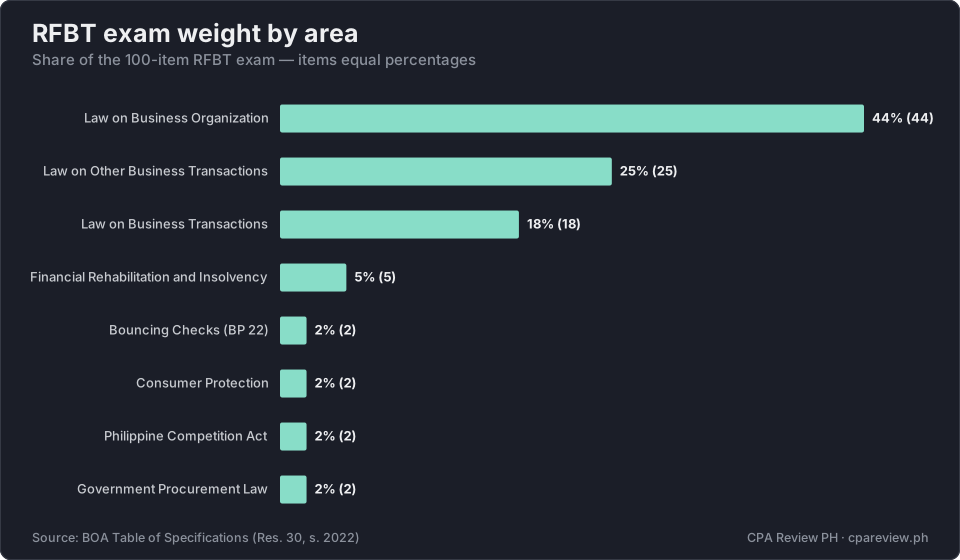
Zoomed out to the resolution's eight top-level lettered areas — the level the chart below plots, rather than the twenty-three-row table above — the same imbalance holds: Law on Business Organization (which contains Corporations) is 44 of the 100 items on its own, and Law on Business Organization plus Law on Other Business Transactions together already account for 69 of 100.
RFBT on the October 2026 CPALE
RFBT sits on Day 2 (October 25, 2026), the afternoon session, right after Taxation — 100 MCQs, more than any other subject on the exam. Filing for the October 2026 CPALE opened July 10, 2026 and closes September 9, 2026, per PRC's 2026 Schedule of Examinations.
If you already sat RFBT in May 2026 and are retaking it in October, the coverage itself does not change: BOA Resolution No. 30, Series of 2022 governs both the May and October 2026 sittings, so the table above is the same table you were tested against the first time — area for area, item for item.
Related
- All six subjects: CPALE Coverage per Subject: Table of Specifications 2026 — the same Table of Specifications data for FAR, AFAR, MAS, Auditing, and Taxation, side by side.
- How to study it: RFBT Guide: Corporation Code & Business Laws for CPALE — this page tells you what is covered and how much each area is worth; that guide tells you how to actually study the corporate-law portion in depth.