Accountancy Week runs July 12–18, 2026 — the third week of July, as it has every year since Proclamation No. 218, s. 2002 set it there. PICPA's theme this year is "EMPOWER: Elevate Filipino CPAs Towards Ethical Leadership and Global Excellence." It's a week built around celebration: chapter events, campus programs, a profession recognizing itself.
It is also a good week to look at what the profession's own numbers say, because they complicate the celebration a little. Roughly the same number of Filipinos sit the CPA board exam today as did a decade ago. But the country licenses noticeably fewer new CPAs from that same pool of candidates — and the reason is not that fewer people are trying.
2015 vs. 2025, side by side
Start with the two years that bookend the comparison. Both had a full May and October sitting with complete PRC-published counts, and both drew almost identical numbers of examinees.
| Metric | 2015 | 2025 | Change |
|---|---|---|---|
| Examinees | 19,276 | 19,704 | +2.2% |
| New CPAs licensed | 7,600 | 6,616 | −984 (−12.9%) |
| Combined passing rate | 39.43% | 33.58% | −5.85 pts |
Almost the same number of people showed up. Nearly a thousand fewer of them left with a license.
The shape of the recovery
That two-point comparison hides a real story in between, and it isn't the one you'd guess from "fewer CPAs than a decade ago." The pipeline didn't decline steadily — it collapsed and then recovered.
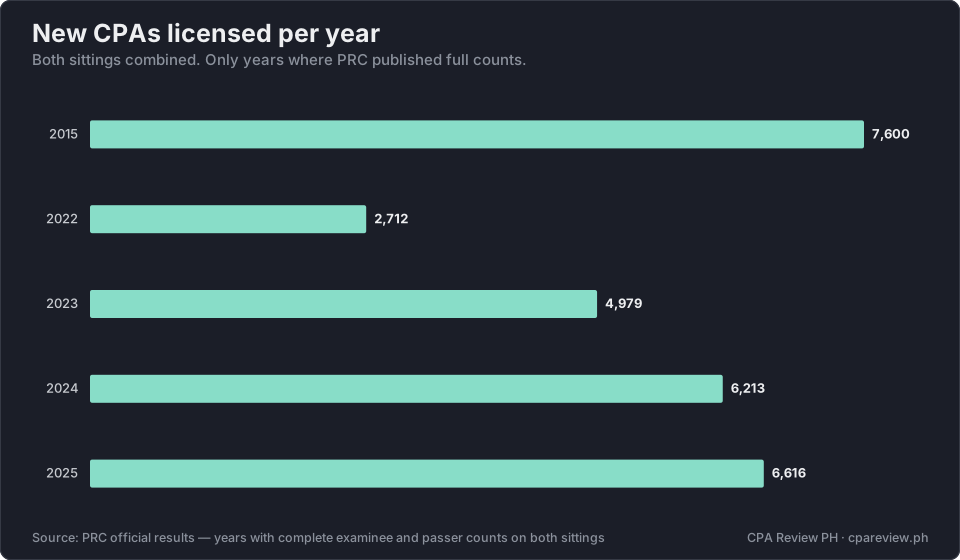
2022 was the trough: only 11,107 examinees sat that year — well under 2015's 19,276 — and the combined passing rate bottomed out at 24.42%, producing just 2,712 new CPAs. That's the COVID-era hole in the pipeline: three consecutive sittings cancelled — May 2020, October 2020, and May 2021 — pushed a backlog of examinees into a compressed post-pandemic reopening, and the system was still absorbing the disruption.
From there, the recovery has been real and fast. Examinees climbed to 16,110 in 2023 (30.91% passing, 4,979 new CPAs), then to 20,557 in 2024 — more than 2015 drew — with a 30.22% rate and 6,213 new CPAs. By 2025, examinees were back to essentially 2015's level (19,704 vs. 19,276) and the rate had recovered further, to 33.58%.
Here's the detail worth sitting with: 2024 actually out-drew 2015 in examinees — 20,557 versus 19,276 — and still produced roughly 1,400 fewer new CPAs. Turnout has recovered. Something else hasn't.
Put this into practice.
AI tutor and a 6-subject question bank, built for the CPALE. Seven days free, no card.
It's not a turnout problem
That "something else" is conversion, not volume. Line up 2015 against 2025 again, but this time on the same axis for examinees and new CPAs.
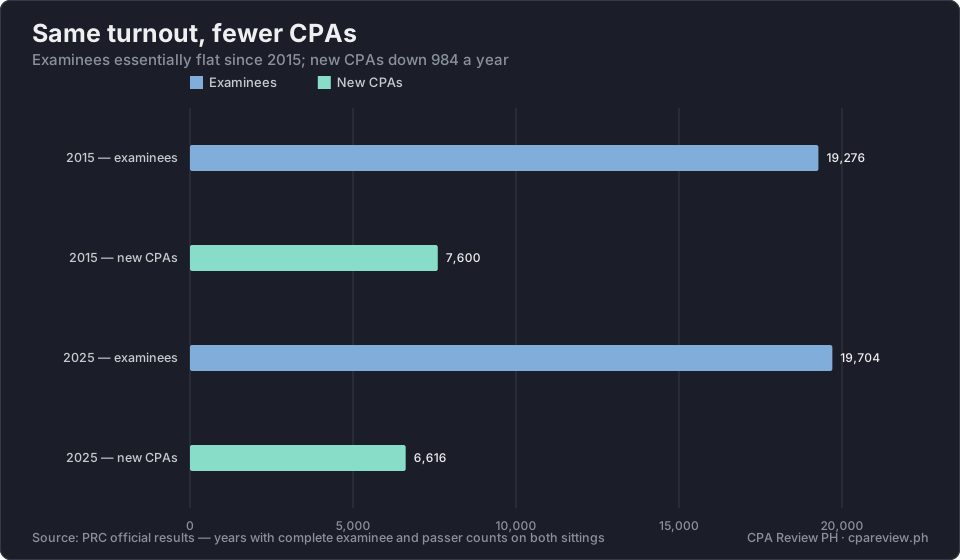
Examinees are up 2.2% since 2015. New CPAs are down 984, or 12.9%. If the pipeline problem were about fewer accounting graduates choosing to sit the exam, the blue bars in that chart would be shrinking too. They aren't — they're flat. The mint bars are the ones moving, because the combined passing rate has settled several points below where it stood in the mid-2010s: 33.58% now against 39.43% then, even after three straight years of recovery from the 2022 low.
The Philippines isn't producing fewer CPA candidates. It's licensing a smaller share of the ones it already has.
Methodology note. This analysis uses only years where PRC published both examinee and passer counts for both sittings: 2015, 2022, 2023, 2024, and 2025. 2016–2019 are excluded because PRC released rate-only figures for several sittings in that stretch, without the underlying counts. 2021 is excluded because it was COVID-disrupted — no May sitting was held that year, only two irregular sittings later in the year. 2026 is excluded because only the May sitting has been held so far; October 2026 hasn't happened yet. A small number of pre-2020 PRC rows also don't fully reconcile between the published counts and the published rate, which is a further reason those years are left out rather than patched. For the complete sitting-by-sitting history, including the years this analysis excludes, see our CPALE passing rate history, 2015–2026.
What this means
For schools. Enrollment recovering to pre-pandemic levels is not the same as production recovering to pre-pandemic levels. A program graduating a class the size of its 2015 cohort should not assume it's sending the same number of them through licensure — the conversion step is where the gap now lives.
For employers. The supply of newly licensed CPAs entering the workforce each year has not caught up to the supply of people attempting to become one. Firms and companies competing for early-career accounting talent are drawing from a pool that's grown more slowly than either turnout or hiring demand.
For the profession's own timeline. The 2029 CPALE restructure — a new six-subject Table of Specifications, including an entirely new Information Systems and Controls subject — is arriving on top of a pipeline that hasn't yet closed this conversion gap. Whether the new structure widens or narrows it is a question the profession will only be able to answer with a few more cycles of data after 2029, the same way this analysis needed a few post-2022 cycles to separate a temporary COVID trough from a durable trend.
None of this is a reason for Accountancy Week to be quieter. The recovery in turnout since the 2022 low is a genuine, encouraging result, and it deserves to be said plainly during a week built for saying it. But "EMPOWER"-ing the next generation of Filipino CPAs also means being honest about where the profession's own numbers say the work still is — and right now, that work is in conversion, not recruitment.
Sources
- PRC official examination results — examinee and passer counts by sitting, compiled from individual PRC board exam result releases, 2015–2026.
- CPALE passing rate history, 2015–2026 — the full sitting-by-sitting table this analysis draws from.
- Proclamation No. 218, s. 2002 — declaring the third week of July as Accountancy Week.
- PRBOA Resolution No. 20, Series of 2026 — the 2029 CPALE Table of Specifications restructure.
Figures verified against PRC-published examinee and passer counts for complete-count years only (2015, 2022, 2023, 2024, 2025). See methodology note above for exclusions.