The Certified Public Accountant Licensure Examination (CPALE) is consistently regarded as one of the most challenging professional licensure exams in the Philippines. Understanding historical passing rates helps aspiring CPAs set realistic expectations and prepare more effectively. This comprehensive guide analyzes CPALE passing rates from 2015 to 2026.
Complete CPALE Passing Rate History (2015-2026)
The following table presents all available CPALE results from 2015 to 2026. The exam has generally followed a twice-yearly May/October cycle, with occasional additional sittings (a December exam was held in both 2021 and 2024).
| Year | Exam Period | Examinees | Passers | Passing Rate |
|---|---|---|---|---|
| 2015 | May 2015 | 5,959 | 2,132 | 35.78% |
| October 2015 | 13,317 | 5,468 | 41.06% | |
| 2016 | May 2016 | - | - | 42.84% |
| October 2016 | 14,390 | 5,249 | 36.48% | |
| 2017 | May 2017 | 9,645 | 3,389 | 35.31% |
| October 2017 | 14,816 | - | ~35.14% | |
| 2018 | May 2018 | 9,830 | 2,843 | 28.92% |
| October 2018 | - | - | 25.18% | |
| 2019 | May 2019 | - | - | 16.46% |
| October 2019 | 14,492 | 2,075 | 14.32% | |
| 2020 | May 2020 | CANCELLED | - | - |
| October 2020 | CANCELLED | - | - | |
| 2021 | May 2021 | CANCELLED | - | - |
| October 2021 | 2,367 | 361 | 15.28% | |
| December 2021 | 1,454 | 318 | 21.87% | |
| 2022 | May 2022 | 4,442 | 990 | 22.29% |
| October 2022 | 6,665 | 1,722 | 25.84% | |
| 2023 | May 2023 | 7,376 | 2,239 | 30.36% |
| September-October 2023 | 8,734 | 2,740 | 31.37% | |
| 2024 | May 2024 | 10,421 | 3,155 | 30.28% |
| December 2024 | 10,136 | 3,058 | 30.17% | |
| 2025 | May 2025 | 9,533 | 3,156 | 33.11% |
| October 2025 | 10,171 | 3,460 | 34.02% | |
| 2026 | May 2026 | 9,745 | 3,004 | 30.83% |
| October 2026 | Scheduled: Oct 24-26 | - | - |
Note: Some exact figures for examinees and passers in 2016-2019 were not available in official sources. Where only percentages were reported, the specific counts are marked with "-".
Key Trends Analysis
The Golden Years (2015-2017): 35-42% Passing Rates
The mid-2010s represented a relatively stable period for CPALE passing rates:
- May 2016 recorded the highest rate at 42.84% during this period
- October exams consistently attracted more examinees than May exams
- October 2015 produced 5,468 CPAs - the highest number in a single exam during 2015-2018
- Average passing rates hovered between 35-42%
This period was characterized by:
- Stable exam coverage and syllabi
- Predictable question patterns
- Higher examinee preparedness
The Decline (2018-2019): The Steepest Drop in History
Starting in 2018, passing rates began a dramatic decline:
- October 2018: 25.18% (first time below 30% since the early 2010s)
- May 2019: 16.46% (sharp drop)
- October 2019: 14.32% (lowest in 65 years since 1954)
Contributing Factors:
- BOA Resolution No. 01 (s. 2019) - Amended syllabi and Tables of Specifications, broadening topic coverage
- Curriculum realignment - Disconnect between academic curricula and licensure requirements
- More rigorous question difficulty - Shift toward application-based questions
- School performance decline - In May 2019, 38% of schools (180 out of 468) had zero passing rates
The COVID-19 Era (2020-2021): Unprecedented Disruption
The pandemic caused the most significant disruption in CPALE history:
- Three consecutive exams cancelled: May 2020, October 2020, May 2021
- Supply gap: Over one year without new CPAs entering the profession
- October 2021: Only 2,367 examinees (vs. typical 10,000-14,000) with 15.28% passing
- No top-performing schools qualified in October and December 2021 exams
The PRC cited the following reasons for cancellations:
- Rising COVID-19 cases
- Health and safety concerns for ~22,000 expected examinees
- Extended community quarantine restrictions
- Fear and anxiety among examinees and personnel
The Recovery Period (2022-2026): Gradual Improvement
Post-pandemic, the CPALE has shown steady recovery:
| Period | Trend |
|---|---|
| 2022 | 22-26% (rebuilding) |
| 2023 | 30-31% (breakthrough) |
| 2024 | 30% (stabilization) |
| 2025 | 33-34% (continued improvement) |
| 2026 | 30.83% in May (return to the ~30% norm) |
Positive Signs:
- Examinees returned to pre-pandemic levels (9,000-10,000+)
- Passing rates crossed the 30% threshold consistently
- Top-performing schools regained qualification status
- October 2025 at 34.02% represents significant recovery
The May 2026 result (30.83%, 3,004 of 9,745 passing) cooled off from the unusually strong 2025 cycles but stayed above the 30% line — effectively a return to the CPALE's long-run norm after two above-average cycles. See our full breakdown of the May 2026 CPALE results.
May vs. October Exam Performance
Historical data reveals interesting patterns between May and October exam cycles:
October Exams Generally Have:
- Higher examinee counts (typically 10,000-14,000 vs. 5,000-10,000 for May)
- More first-time takers (fresh graduates from the previous academic year)
- Higher number of passers (due to larger pool)
- Variable passing rates (can be higher or lower than May)
May Exams Generally Have:
- Smaller examinee pools (reviewees who postponed from October)
- Higher proportion of repeaters (retakers from previous October)
- More focused examinees (those who specifically chose to delay)
Historical Comparison:
| Year | May Rate | October Rate | Higher Performer |
|---|---|---|---|
| 2015 | 35.78% | 41.06% | October |
| 2016 | 42.84% | 36.48% | May |
| 2017 | 35.31% | ~35.14% | Similar |
| 2018 | 28.92% | 25.18% | May |
| 2019 | 16.46% | 14.32% | May |
| 2022 | 22.29% | 25.84% | October |
| 2023 | 30.36% | 31.37% | October |
| 2024 | 30.28% | 30.17%* | Similar |
| 2025 | 33.11% | 34.02% | October |
| 2026 | 30.83% | Oct 24-26 | TBD |
*Note: 2024 October exam was held in December
Factors Affecting CPALE Passing Rates
1. Curriculum and Syllabus Changes
The Board of Accountancy periodically updates the CPALE coverage:
- BOA Resolution No. 01 (s. 2019): Expanded syllabi, contributing to the 2019 drop
- BOA Resolution No. 30 (s. 2022): Revised syllabi effective October 2022, including:
- Removal of "Updates on Special Concerns"
- Removal of Tariff and Custom Codes under Tax
- Removal of Standard Costing under AFAR
- Removal of Negotiable Instruments under RFBT
2. Question Difficulty and Format
Modern CPALE questions emphasize:
- Application over memorization: Scenario-based questions
- Integration across subjects: Multi-disciplinary problems
- Current standards compliance: Updated PFRS/PSA requirements
3. School Preparation Quality
Research indicates significant variance in school performance:
- Top schools: 90-100% passing rates (UP Diliman consistently leads)
- Average schools: 20-40% passing rates
- Underperforming schools: 0-15% passing rates
In the May 2019 CPALE, 65% of schools performed below the national passing rate.
4. Economic and External Factors
- Pandemic disruptions (2020-2021): Cancelled exams, online learning challenges
- Review center accessibility: Geographic and financial barriers
- Career timing pressures: Employment opportunities vs. study time
Put this into practice.
AI tutor and a 6-subject question bank, built for the CPALE. Seven days free, no card.
The Data, Visualized
The numbers above tell a clearer story once you chart them. Here are the three views that matter most for an examinee sizing up the odds.
Passing rate over time (2015–2026)
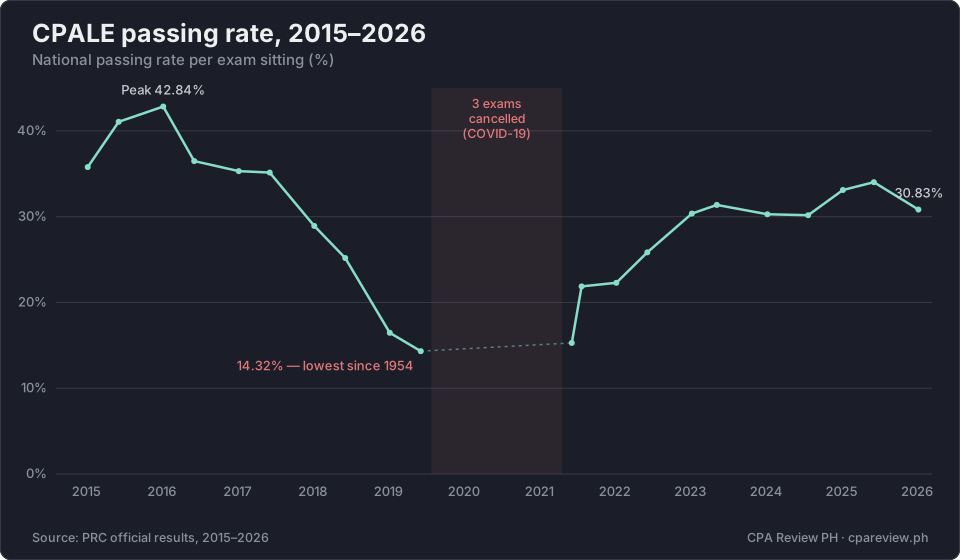
The shape of the curve says it all: a high-30s-to-40s plateau through 2016, a steep slide into the 2019 trough (14.32%, the lowest since 1954), the COVID gap when three straight exams were cancelled, and a steady climb back to the ~30–34% band that now looks like the new normal.
Examinees vs. passers per sitting
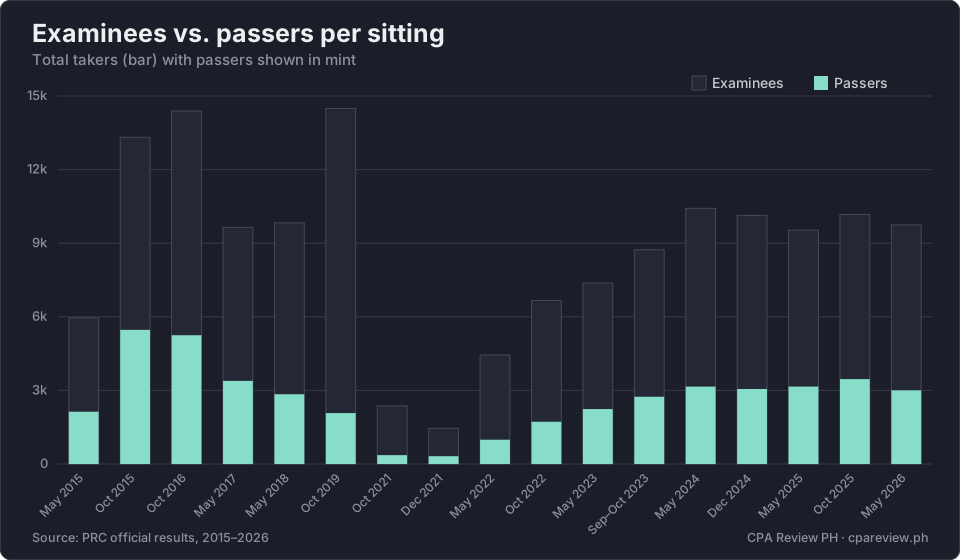
Each bar is the total number of examinees; the mint portion is how many passed. Two things stand out — the collapse in turnout during 2021 (just 2,367 sat the October exam, versus the usual 10,000+), and the full return to pre-pandemic volumes from 2024 onward.
May vs. October performance
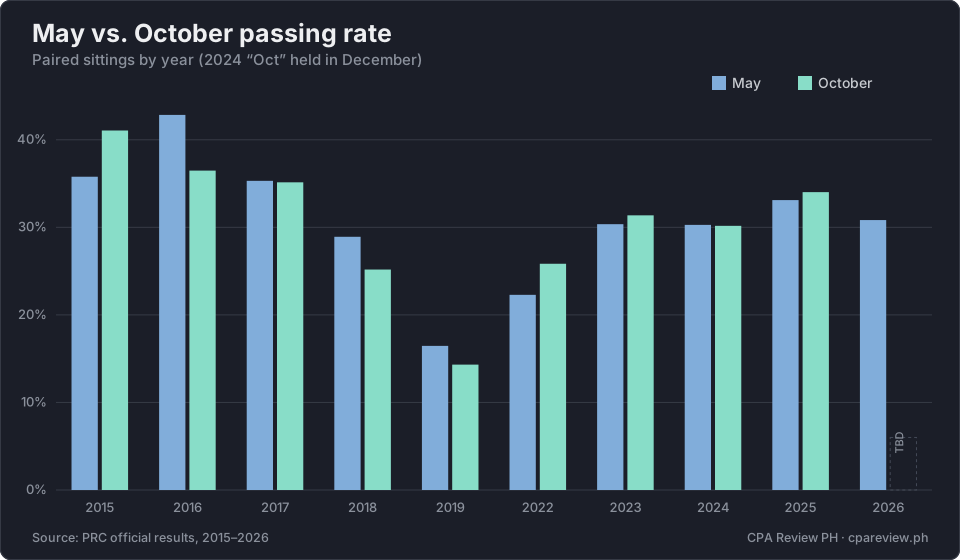
There is no reliably "easier" sitting. October edged out May in some years (2015, 2022, 2023, 2025) and May won in others (2016, 2018, 2019) — but the gap is almost always just a few points. Pick your exam date around your own preparation timeline, not a seasonal advantage.
School-level performance varies far more than any of these national figures. For the full breakdown by institution — including first-time vs. repeater rates across 500+ schools — see our May 2026 CPALE school performance report.
What This Means for Future Examinees
Setting Realistic Expectations
Based on historical data:
- Current benchmark: Expect ~30-35% national passing rates
- Personal target: Aim for the top 30% of examinees
- Subject preparation: No subject should be neglected (65% minimum per subject required)
Strategic Preparation Tips
- Start early: The complexity requires 6-12 months of dedicated review
- Choose your exam date wisely: Consider whether May or October suits your preparation timeline
- Focus on weak areas: The 65% minimum per subject rule has eliminated many otherwise qualified candidates
- Stay updated: Monitor BOA resolutions for syllabus changes
Upcoming 2026 CPALE Schedule
| Exam | Dates | Filing Period |
|---|---|---|
| May 2026 | May 24-26, 2026 | Feb 6 - Apr 10, 2026 |
| October 2026 | October 24-26, 2026 | Jul 10 - Sep 9, 2026 |
Historical Context: The Bigger Picture
For perspective, here are some notable historical CPALE statistics:
- Lowest passing rate ever: 6.48% in 1954 (152 out of 2,345 examinees)
- Highest modern passing rate: 48.36% in October 2010 (3,973 out of 8,216)
- Total examinees since 1932: Over 718,000
- Total CPAs produced since 1932: Over 182,000 (approximately 25% overall)
- First CPA exam: May 1932
The CPALE has consistently been more difficult than many other licensure exams. Notably, during the 2019-2021 period, the CPALE passing rate was even lower than the notoriously difficult Bar Examination for lawyers.
Conclusion
The CPALE passing rate history from 2015 to 2026 tells a story of challenge, disruption, and recovery. While the exam remains one of the most difficult professional licensure examinations in the Philippines, recent trends suggest a stabilization around 30-35% passing rates.
For aspiring CPAs, understanding these historical trends provides:
- Realistic expectations about the difficulty level
- Strategic insights for exam timing decisions
- Motivation from seeing the recovery trend post-pandemic
Success in the CPALE requires not just knowledge, but strategic preparation, mental resilience, and consistent effort. The statistics show that while the odds may seem challenging, thousands of Filipinos pass the exam every cycle.
Prepare with Confidence at CPA Review PH
At CPA Review PH, we provide AI-powered review tools designed specifically for the Philippine CPALE:
- Subject-specific practice questions aligned with BOA Resolution No. 30
- AI tutor that adapts to your learning pace and weak areas
- Mock exams simulating the actual 3-day exam format
- Updated study materials reflecting current PFRS, PSA, and tax law changes
Whether you are targeting the May 2026 or October 2026 CPALE, start your preparation today and join the thousands of successful CPAs who passed before you.
Start Your Free Trial | View Study Plans
Sources
- PRC Official Website - Exam Results
- Board Exams PH - CPALE Performance of Schools
- Business Mirror - Trends in the Philippines' CPA Licensure Examinations
- Daily Guardian - On the Notorious Passing Rate of the CPALE
- ACPAPP - No Joy in Higher Passing Rate
- European Journal of Educational Research - Five-Year Declining Performance Study
- Inquirer News - 2,239 Pass May 2023 CPALE
- PRC Board News - CPALE Results
- 1taker - CPA Board Exam Guide 2026
- QNE Cloud - CPA 2025 Results
Last updated: June 2026, with the official May 2026 CPALE results (30.83%). Statistics compiled from official PRC releases and verified news sources.