Philippine CPA vs US CPA: Which License Should You Pursue?
As a Filipino accounting professional, you've likely wondered whether to pursue the Philippine CPA license, the US CPA credential, or both. This decision can significantly impact your career trajectory, earning potential, and professional opportunities.
In this comprehensive guide, we'll break down everything you need to know about both certifications to help you make an informed decision that aligns with your career goals.
Quick Comparison: Philippine CPA vs US CPA
| Aspect | Philippine CPA (CPALE) | US CPA |
|---|---|---|
| Governing Body | Professional Regulation Commission (PRC) | Individual State Boards of Accountancy |
| Exam Format | 6 subjects over 3 days | 4 sections (flexible scheduling) |
| Total Questions | 450 MCQs | Varies by section (MCQs + simulations) |
| Passing Score | 75% overall average | 75 per section (scaled score) |
| Total Cost (PHP) | ~15,000 - 40,000 | ~200,000 - 500,000 |
| Exam Frequency | Twice yearly (May & October) | Year-round (continuous testing) |
| Time to Complete | 3 days (single attempt) | 18-month window per section |
| Primary Recognition | Philippines | United States (global recognition) |
| Language | English/Filipino | English |
Understanding the Philippine CPA License (CPALE)
What is CPALE?
The Certified Public Accountant Licensure Examination (CPALE) is administered by the Board of Accountancy (BOA) under the Professional Regulation Commission (PRC). It's the mandatory credential for practicing public accountancy in the Philippines.
CPALE Exam Structure
Per BOA Resolution No. 30, Series of 2022, the Philippine CPA board exam is conducted over three consecutive days:
| Day | Morning Session (8:00 AM - 12:00 NN) | Afternoon Session (2:00 PM - 6:00 PM) |
|---|---|---|
| Day 1 | Management Advisory Services (MAS) - 70 MCQs | Auditing - 70 MCQs |
| Day 2 | Taxation - 70 MCQs | Regulatory Framework for Business Transactions (RFBT) - 100 MCQs |
| Day 3 | Financial Accounting and Reporting (FAR) - 70 MCQs | Advanced Financial Accounting and Reporting (AFAR) - 70 MCQs |
Total: 450 multiple-choice questions over 3 days (5 subjects × 70 + RFBT × 100)
Philippine CPA Requirements
Educational Requirements:
- Bachelor's degree in Accountancy (BSA) from a CHED-recognized institution
- Completion of all required accounting subjects as prescribed by CHED
Application Requirements:
- NSO/PSA Birth Certificate
- Transcript of Records with Special Order (S.O.) number
- Certificate of Good Moral Character
- Valid ID photos
- Application forms from PRC
Post-Licensure Requirements:
- Oath-taking ceremony
- CPD (Continuing Professional Development) units for license renewal
- 60 CPD units every 3 years
CPALE Costs Breakdown
| Item | Estimated Cost (PHP) |
|---|---|
| PRC Application Fee | 900 |
| Examination Fee | 1,500 |
| Review Center (Optional) | 10,000 - 30,000 |
| Review Materials | 2,000 - 5,000 |
| Miscellaneous (Travel, Accommodation) | 1,000 - 5,000 |
| Total Estimated Cost | 15,400 - 42,400 |
Understanding the US CPA License
What is the US CPA?
The US CPA credential is administered by the American Institute of Certified Public Accountants (AICPA) and the National Association of State Boards of Accountancy (NASBA). It's widely regarded as one of the most prestigious accounting certifications globally.
US CPA Exam Structure (2024 CPA Evolution Model)
The US CPA exam underwent significant changes with the CPA Evolution model. The current structure includes:
Core Sections (Required for all candidates):
| Section | Content | Format |
|---|---|---|
| AUD - Auditing and Attestation | Audit procedures, ethics, attestation engagements | 4 hours, MCQs + TBS |
| FAR - Financial Accounting and Reporting | US GAAP, IFRS fundamentals, governmental accounting | 4 hours, MCQs + TBS |
| REG - Taxation and Regulation | Federal taxation, business law, ethics | 4 hours, MCQs + TBS |
Discipline Section (Choose one):
| Section | Focus Area |
|---|---|
| BAR - Business Analysis and Reporting | Financial statement analysis, technical accounting |
| ISC - Information Systems and Controls | IT governance, cybersecurity, data management |
| TCP - Tax Compliance and Planning | Advanced tax planning, complex tax scenarios |
US CPA Requirements for Filipino Candidates
Educational Requirements:
- Bachelor's degree (evaluated for US equivalency)
- 120-150 semester hours (varies by state)
- Specific accounting and business credit hours
- Some states require ethics courses
Credential Evaluation: Filipinos must have their credentials evaluated by approved agencies:
- NASBA International Evaluation Services (NIES)
- Foreign Academic Credentials Service (FACS)
- World Education Services (WES)
Popular State Boards for International Candidates:
- Guam - No US residency required, 120 credit hours
- Montana - No US citizenship/residency required
- Colorado - Accepts international candidates
- Washington - No SSN required for exam
Experience Requirements:
- 1-2 years of supervised accounting experience (varies by state)
- Must be verified by a licensed CPA
US CPA Costs for Filipino Candidates
| Item | Estimated Cost (PHP) |
|---|---|
| Credential Evaluation | 15,000 - 25,000 |
| Application Fee | 10,000 - 15,000 |
| Examination Fees (4 sections) | 80,000 - 100,000 |
| Review Course (Becker, Wiley, etc.) | 80,000 - 150,000 |
| Prometric Testing Center Fees | 20,000 - 40,000 |
| Travel (if testing abroad) | 30,000 - 100,000 |
| License Application Fee | 5,000 - 10,000 |
| Total Estimated Cost | 240,000 - 440,000 |
Note: Costs can reach PHP 500,000+ if multiple retakes are needed or if traveling to the US for testing.
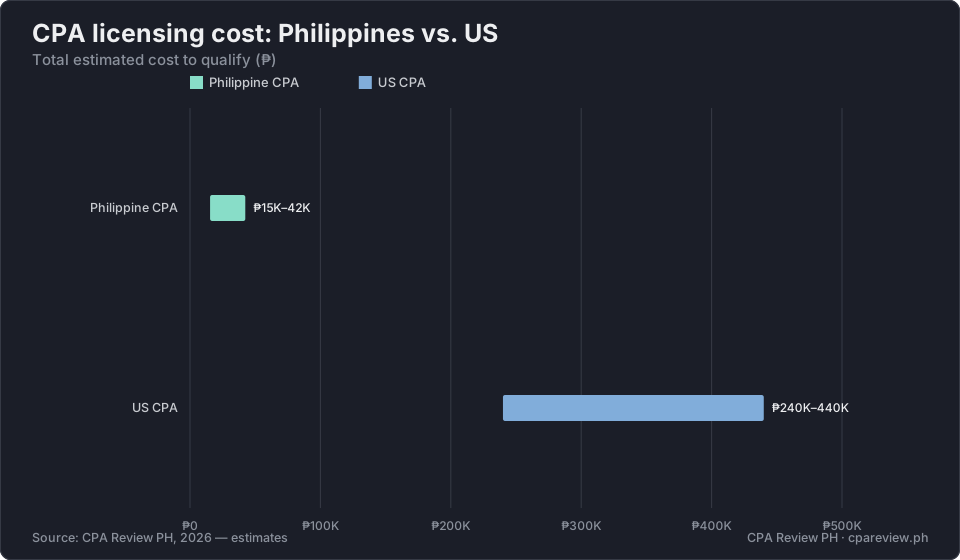
Qualifying as a US CPA costs roughly 10–15× what the Philippine CPALE does — the central trade-off behind the "which license" decision. (Estimates.)
Salary Comparison
Philippine CPA Salary Ranges
| Position | Annual Salary (PHP) |
|---|---|
| Staff Accountant (Entry-level) | 180,000 - 300,000 |
| Senior Accountant | 300,000 - 500,000 |
| Accounting Manager | 500,000 - 800,000 |
| Finance Manager | 600,000 - 1,000,000 |
| CFO/Finance Director | 1,200,000 - 3,000,000+ |
| Public Practice (Big 4 Entry) | 240,000 - 360,000 |
| Public Practice (Manager) | 800,000 - 1,500,000 |
| Public Practice (Partner) | 3,000,000 - 10,000,000+ |
US CPA Holder Salary in the Philippines
Filipino professionals with US CPA credentials typically command significantly higher salaries:
| Position | Annual Salary (PHP) |
|---|---|
| Staff Accountant (BPO/Shared Services) | 400,000 - 600,000 |
| Senior Accountant | 600,000 - 1,000,000 |
| Manager (Multinational) | 1,200,000 - 2,000,000 |
| Senior Manager/Director | 2,000,000 - 4,000,000 |
| Finance Leadership (Regional Roles) | 3,000,000 - 8,000,000+ |
Key Insight: US CPA holders working in the Philippines typically earn 2-3x more than their Philippine CPA-only counterparts in similar roles, particularly in:
- Multinational corporations
- BPO/Shared services centers
- Big 4 firms with US-focused engagements
- Regional finance hubs
Working Abroad Comparison
| Location | PH CPA Annual Salary | US CPA Annual Salary |
|---|---|---|
| Philippines | PHP 300,000 - 800,000 | PHP 600,000 - 2,000,000 |
| Singapore | SGD 40,000 - 80,000 | SGD 60,000 - 150,000 |
| UAE/Middle East | AED 80,000 - 200,000 | AED 150,000 - 400,000 |
| United States | Limited opportunities | USD 60,000 - 150,000 |
| Australia | Limited recognition | AUD 70,000 - 130,000 |
Preparing for the CPALE?
When you start reviewing, the AI tutor and full question bank are free for seven days — no card.
Career Paths
Philippine CPA Career Paths
Public Practice:
- External Auditor
- Tax Consultant
- Management Consultant
- Forensic Accountant
Private Industry:
- Corporate Accountant
- Financial Analyst
- Internal Auditor
- Controller/Comptroller
- Chief Financial Officer
Government:
- Bureau of Internal Revenue (BIR)
- Commission on Audit (COA)
- Department of Finance (DOF)
- Government-Owned Corporations
Academia:
- Accounting Professor
- Academic Administrator
- Researcher
US CPA Career Paths
International Opportunities:
- Big 4 Accounting Firms (Global)
- Multinational Corporations
- International Financial Institutions
- Global Consulting Firms
Specialized Roles:
- US Tax Specialist
- SOX Compliance Expert
- US GAAP Reporting Specialist
- International Audit Lead
BPO/Shared Services (Philippines):
- US Accounting Team Lead
- Financial Reporting Manager
- Process Excellence Manager
- Transition Lead
Remote Work Opportunities:
- US-based companies hiring remote accountants
- Freelance US tax preparation
- Consulting for US subsidiaries in Asia
Who Should Pursue Which License?
Pursue Philippine CPA If You:
- Plan to practice in the Philippines - Required for signing financial statements and audit reports in PH
- Want to work in government - Essential for BOA, COA, BIR positions
- Prefer lower upfront investment - More affordable path to professional certification
- Want to start your career sooner - Can take the exam immediately after graduation
- Plan to open your own practice - Required for establishing an accounting firm in PH
- Value local professional network - Strong PICPA community and local recognition
Pursue US CPA If You:
- Target multinational companies - Preferred credential for US-based MNCs
- Want to work abroad - Greater international mobility and recognition
- Aim for higher salary - Significantly higher earning potential
- Work in BPO/Shared Services - Many US-focused roles require or prefer US CPA
- Plan to specialize in US taxation - Essential for US tax practice
- Want global career flexibility - Opens doors in multiple countries
Pursue Both If You:
- Want maximum career flexibility - Best of both worlds
- Plan to work in Big 4 - Valuable for both local and international engagements
- Target leadership roles - Dual credentials demonstrate exceptional competence
- Can afford the investment - Higher upfront cost but greater long-term ROI
- Want to future-proof your career - Prepared for any opportunity
Strategic Approach: Recommended Path
For Fresh Graduates:
-
First: Pass the Philippine CPA exam (CPALE)
- Take it within 1-2 years of graduation while knowledge is fresh
- Lower cost and essential for practicing in PH
- Build your foundation and gain work experience
-
Then: Consider US CPA after 2-3 years
- By then, you'll have clearer career goals
- Work experience makes the material more relatable
- Employer may sponsor your review and exam fees
For Working Professionals:
-
Evaluate your current trajectory
- Are you hitting a ceiling with just PH CPA?
- Does your company value or require US CPA?
- What roles are you targeting in 5 years?
-
Consider employer support
- Many BPOs and multinationals offer US CPA sponsorship
- Some provide study leave and bonuses for passing
Timeline Considerations
| Milestone | Philippine CPA | US CPA |
|---|---|---|
| Preparation Time | 6-12 months | 12-18 months |
| Exam Duration | 3 days | 12-18 months (4 sections) |
| Results Release | ~3-6 working days | ~2-3 weeks per section |
| Total Time to License | 8-14 months | 18-30 months |
Frequently Asked Questions
Can I take the US CPA exam without a Philippine CPA license?
Yes. The US CPA and Philippine CPA are independent credentials. You can pursue US CPA without passing CPALE, though most Filipino professionals obtain the Philippine license first since it's more accessible and provides a strong foundation.
Is the US CPA harder than the Philippine CPA?
They test different competencies. The US CPA covers US GAAP, US taxation, and US business law, which may be unfamiliar to Filipino candidates. However, the US CPA allows sectional testing over 18 months, while CPALE requires passing all subjects in one sitting. Many consider the pressure of CPALE's format more challenging.
Can I practice in the Philippines with only a US CPA?
No. To practice public accountancy in the Philippines (sign audit reports, prepare tax returns for others), you must hold a Philippine CPA license issued by PRC. However, you can work in private industry roles with a US CPA only.
Do US CPA credentials expire?
US CPA licenses require renewal and CPE (Continuing Professional Education) requirements, which vary by state. Most states require 40 CPE hours annually or 80 hours biennially.
Which Big 4 firms in the Philippines prefer US CPA holders?
All Big 4 firms (SGV/EY, Isla Lipana/PwC, KPMG, Deloitte) value US CPA credentials, particularly for:
- US-focused audit engagements
- Advisory services for multinational clients
- Secondment opportunities to US offices
Making Your Decision
The choice between Philippine CPA and US CPA ultimately depends on your:
- Career goals - Where do you want to work in 5-10 years?
- Financial capacity - Can you invest PHP 200,000-500,000 for US CPA?
- Time commitment - Can you dedicate 12-18 months for US CPA preparation?
- Risk tolerance - Are you comfortable with the US CPA's longer, more expensive path?
For most Filipino accounting professionals, we recommend this approach:
Pass CPALE first, then evaluate US CPA based on your career trajectory and employer support.
This strategy ensures you have the foundational Philippine license while keeping options open for international credentials.
Start Your CPA Journey with CPA Review PH
Whether you're preparing for the Philippine CPA exam or building the foundation for future credentials, a solid preparation strategy is essential.
CPA Review PH offers an AI-powered study platform specifically designed for the Philippine CPA Licensure Examination (CPALE). Our platform features:
- AI-Powered Tutoring - Get personalized explanations and guidance
- Complete Coverage - All 6 CPALE subjects with practice questions
- Adaptive Learning - Study at your own pace with smart recommendations
- Mock Exams - Simulate the actual 3-day exam experience
- Affordable Plans - Start with a free trial, then choose per-subject or complete bundles
Ready to pass the CPA board exam?
Start Your Free Trial at cpareview.ph
Sources
- Professional Regulation Commission (PRC). "Board of Accountancy - CPA Licensure Examination Guidelines." https://www.prc.gov.ph
- Board of Accountancy Resolution No. 30, Series of 2022. "Revised Syllabus for CPALE."
- American Institute of Certified Public Accountants (AICPA). "CPA Evolution." https://www.aicpa.org
- National Association of State Boards of Accountancy (NASBA). "International Candidate Requirements." https://www.nasba.org
- Philippine Institute of Certified Public Accountants (PICPA). "Membership and Professional Standards." https://www.picpa.com.ph
- JobStreet Philippines. "Salary Guide 2025-2026: Accounting and Finance."
- Robert Walters. "Asia Salary Survey 2025."
- Becker Professional Education. "US CPA Exam Information for International Candidates."
- Commission on Higher Education (CHED). "BSA Program Requirements and Standards."
- Bureau of Internal Revenue (BIR). "Accreditation Requirements for CPAs."