What Is the ASEAN CPA and How Can Filipino Accountants Work Abroad?
The ASEAN CPA (ACPA) is an international credential that allows qualified Filipino CPAs to practice accountancy in Singapore, Malaysia, Thailand, and 7 other ASEAN countries without retaking a foreign licensing exam. To qualify, you need a valid PRC-CPA license, at least 3 years of post-licensure experience, and CPD compliance. After obtaining the ACPA, you register as an RFPA (Registered Foreign Professional Accountant) in your target country.
Many Filipino CPAs dream of working abroad, and the ASEAN Mutual Recognition Arrangement on Accountancy Services (MRAA) makes that dream more achievable than ever. Through the ASEAN CPA (ACPA) credential, qualified Filipino accountants can practice in Singapore, Malaysia, Thailand, and other ASEAN countries without retaking a foreign licensing exam.
This guide covers everything you need to know about the ASEAN CPA arrangement — from eligibility requirements to the application process, what you can and cannot do abroad, and realistic salary expectations.
What is the ASEAN MRA on Accountancy Services?
The ASEAN Mutual Recognition Arrangement on Accountancy Services is a multilateral agreement signed by all 10 ASEAN member states. The framework agreement was originally signed on February 26, 2009, in Cha-am, Thailand, with the full multilateral MRA finalized in November 2014.
The arrangement enables qualified professional accountants from one ASEAN country to provide accountancy services in another ASEAN country, subject to the host country's domestic regulations.
Participating Countries
All 10 ASEAN member states participate:
| Country | National Accountancy Body |
|---|---|
| Philippines | PRC / BOA / PICPA |
| Singapore | ISCA (Institute of Singapore Chartered Accountants) |
| Malaysia | MIA (Malaysian Institute of Accountants) |
| Thailand | FAP (Federation of Accounting Professions) |
| Indonesia | IAI (Ikatan Akuntan Indonesia) |
| Vietnam | VAA (Vietnam Association of Accountants and Auditors) |
| Myanmar | MAC (Myanmar Accountancy Council) |
| Cambodia | KICPAA |
| Brunei | BICPA |
| Lao PDR | LICPA |
Understanding ASEAN CPA vs. RFPA
Two key terms you need to understand:
ASEAN CPA (ACPA)
The ASEAN Chartered Professional Accountant is an international credential recognized across all 10 ASEAN member states. It certifies that a CPA from one country meets the agreed-upon qualifications and experience standards. Think of it as a "passport" for your professional credentials.
RFPA (Registered Foreign Professional Accountant)
An RFPA is an ASEAN CPA who has registered with a specific host country to provide accountancy services there. Each country you want to practice in requires a separate RFPA registration.
The relationship:
- First, obtain your ASEAN CPA credential (one-time, recognized everywhere)
- Then, register as an RFPA in each country where you want to work
Eligibility Requirements for Filipino CPAs
To qualify as an ASEAN CPA, you must meet ALL of the following:
| Requirement | Details |
|---|---|
| Nationality | Filipino citizen |
| Education | BS Accountancy degree from a CHED-accredited institution |
| Professional License | Current and valid CPA license from PRC |
| Experience | Minimum 3 years of practical experience within any 5-year period prior to application |
| CPD Compliance | Minimum 120 CPD units over the preceding 3-year cycle |
| Good Standing | No record of serious professional or ethical violations; no pending cases |
Key Points
- No additional qualifying exam. Unlike pursuing a US CPA license, the ASEAN CPA is based on credentials verification only.
- The 3-year experience requirement is the same as what is needed for BOA accreditation. If you are BOA-accredited, you likely already meet this requirement.
- CPD compliance requires 120 units per 3-year cycle, as mandated by BOA Resolution No. 53, Series of 2022.
How to Apply for ASEAN CPA (Philippines)
The ASEAN CPA registration in the Philippines is administered by the ASEAN Monitoring Committee on Professional Accountancy Services of the Philippines (AMCPASP), a joint committee of PRC and PICPA. Registration officially commenced on January 31, 2025.
Step-by-Step Application Process
Step 1: Prepare CPD Documentation
- Submit a letter request to PRC CPD Division
- Attach photocopies of all CPD certificates from the past 3 years (minimum 120 units)
- Obtain your CPD Compliance Certificate
Step 2: Obtain Good Standing Certificates
- Certificate of Good Standing from PICPA
- Certificate of No Pending Case from PRC
Step 3: Compile Required Documents
Prepare the following in a ring-bound folder:
| Document | Notes |
|---|---|
| Original PRC License (COR) | Current and valid |
| Professional ID Card | Current PRC ID |
| PICPA Certificate | Membership or good standing |
| CPD Compliance Certificate | From PRC |
| Certificate of No Pending Case | From PRC |
| Passport-size photos (2x2) | White background, with name tag |
| Proof of work experience | Employment certificates covering at least 3 years |
Step 4: Submit Application
- File at the nearest PRC Regional Office — Regulations Division
- Pay the application fee
Step 5: AMCPASP Evaluation
- PRC forwards your documents to AMCPASP
- The committee evaluates completeness and eligibility
- You may be asked to submit additional documents
Step 6: Final Payment and Submission
- Upon preliminary approval, pay the final fee
- Email proof of payment and an updated 2x2 photo to the designated PRC email
Step 7: Receive Your ASEAN CPA Credential
- ASEAN CPA ID and Certificate of Registration are awarded at a conferment ceremony
Tip: Start gathering your documents early. The CPD Compliance Certificate alone can take several weeks to process through PRC.
What ASEAN CPAs Can and Cannot Do Abroad
Understanding the scope and limitations of the ASEAN CPA credential is critical before making career plans.
Services You CAN Provide
As an ASEAN CPA or RFPA in a host country, you can:
- Provide accounting and bookkeeping services
- Perform internal auditing
- Compile and report on financial statements
- Offer management advisory services related to accounting
- Provide tax accounting and advisory services
- Work as an employee of commercial, industrial, or educational entities
- Work as a consultant to businesses
- Participate in external audit engagements in collaboration with a designated local auditing firm
Services You CANNOT Provide
There are important restrictions:
- You cannot sign independent auditor's reports. This must be done by a locally licensed auditor in the host country.
- You cannot practice independently without local collaboration or employment arrangements.
- You cannot set up a sole practice without host country approval.
- You must comply with the host country's domestic laws, immigration policies, and professional regulations.
Practical Implications
In practice, most Filipino ASEAN CPAs abroad work in one of these arrangements:
- Employed by a local accounting firm — the most common path, especially in Singapore's Big Four offices
- Employed by a multinational corporation — finance/accounting roles in regional offices
- Consultant to local firms — providing specialized expertise while partnered with a local practitioner
The ASEAN CPA credential removes the professional licensing barrier, but you still need to secure employment or a business partnership independently, and comply with immigration requirements (work visa/permit).
Preparing for the CPALE?
When you start reviewing, the AI tutor and full question bank are free for seven days — no card.
Country-by-Country Opportunities
Singapore — The Top Destination
Singapore is the most popular destination for Filipino CPAs abroad, offering the highest salaries and the most established RFPA framework through ISCA.
| Level | Annual Salary (SGD) | Approx. PHP Equivalent |
|---|---|---|
| Entry-level CPA (1-3 years) | SGD 64,000 | ~PHP 2.6 million |
| Mid-career CPA | SGD 90,000 | ~PHP 3.6 million |
| Senior CPA (8+ years) | SGD 112,000+ | ~PHP 4.5 million+ |
Why Singapore:
- Strong demand for accounting professionals (estimated 20,000+ CPAs needed)
- English-speaking business environment
- Well-established RFPA registration process through ISCA
- Hub for regional headquarters of multinational companies
- Proximity to the Philippines (3-4 hour flight)
How to Register as RFPA in Singapore:
- Apply through ISCA (Institute of Singapore Chartered Accountants)
- Submit ASEAN CPA credential plus additional local requirements
- Visit isca.org.sg for current application details
Malaysia — Growing Demand
Malaysia has significant demand for English-fluent accountants, with an estimated 30,000 accountants needed across the country.
| Level | Annual Salary (MYR) | Approx. PHP Equivalent |
|---|---|---|
| General Accountant | MYR 52,000 | ~PHP 640,000 |
| CPA/Chartered Accountant | MYR 65,000-80,000 | ~PHP 800,000 - 985,000 |
| Senior/Manager | MYR 90,000+ | ~PHP 1.1 million+ |
Why Malaysia:
- English widely used in business
- Lower cost of living than Singapore
- Growing financial services sector (especially Islamic finance)
- Cultural familiarity for Filipinos
- Apply through MIA (Malaysian Institute of Accountants)
Thailand — Emerging Opportunity
Thailand's growing economy creates opportunities, particularly in Bangkok's international business district.
| Level | Annual Salary (THB) | Approx. PHP Equivalent |
|---|---|---|
| Entry-level (1-4 years) | THB 360,000 | ~PHP 600,000 |
| Mid-career CPA | THB 760,000 | ~PHP 1.3 million |
| Senior Accountant | THB 950,000+ | ~PHP 1.6 million+ |
Why Thailand:
- Lower cost of living offsets lower nominal salaries
- Growing demand in manufacturing and tourism sectors
- Bangkok is a regional business hub
- Apply through FAP (Federation of Accounting Professions)
Indonesia, Vietnam, and Other ASEAN Countries
Opportunities exist in Indonesia (especially Jakarta) and Vietnam (Ho Chi Minh City, Hanoi), driven by rapid economic growth. However, language barriers are more significant in these countries, and salary levels are generally lower than Singapore or Malaysia.
Salary Disclaimer: All figures are estimates based on 2025-2026 data from PayScale, Glassdoor, and regional salary surveys. Actual compensation varies by employer, specific role, and negotiation. Exchange rates fluctuate.
Comparing Your Options
| Factor | Stay in PH | Singapore | Malaysia | Thailand |
|---|---|---|---|---|
| Average CPA Salary | PHP 420,000-600,000/yr | PHP 3.6M/yr | PHP 800K-985K/yr | PHP 1.3M/yr |
| Cost of Living | Baseline | Very high | Moderate | Low-moderate |
| Language Barrier | None | Low (English) | Low (English) | Moderate |
| Career Growth | Good | Excellent | Good | Good |
| Signing Audit Reports | Yes (with BOA accreditation) | No (need local license) | No | No |
| Family Proximity | Home | 3-4 hr flight | 3-4 hr flight | 3 hr flight |
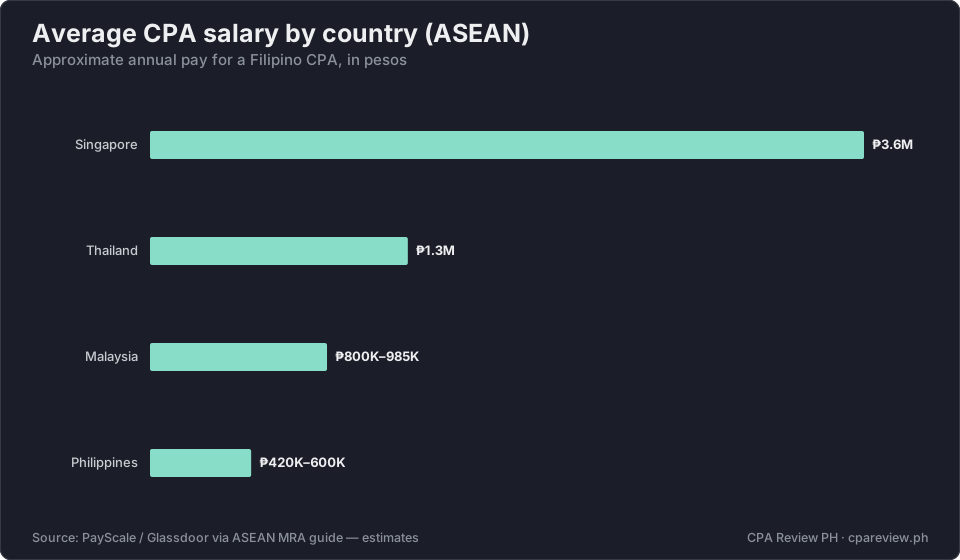
A CPA role in Singapore pays several times the Philippine average — the headline draw of the ASEAN mutual-recognition route. (Estimates; exchange rates fluctuate.)
Preparing for an ASEAN Career
If you are considering working abroad as an ASEAN CPA, here is a practical roadmap:
While Still Reviewing for the CPALE
Focus on passing the board exam first. Everything else follows from this. Your CPA license is the non-negotiable foundation.
Year 1-3 After Passing
- Gain meaningful work experience — at least 3 years in accounting, auditing, or advisory roles
- Maintain CPD compliance — accumulate 120 units per 3-year cycle
- Join PICPA — membership facilitates the ASEAN CPA application
- Build specialized skills — IFRS expertise, data analytics, and industry specialization make you more competitive abroad
When Ready to Apply
- Apply for ASEAN CPA through PRC
- Research target countries and their RFPA requirements
- Network with Filipino CPAs already working in your target country
- Prepare for immigration requirements (work visa, employment pass)
- Register as RFPA in your target country
Useful Resources
- ASEAN CPA Secretariat — official ASEAN CPA information
- PRC ASEAN MRA Page — Philippine application guidance
- ISCA Singapore RFPA — Singapore registration
- MIA Malaysia — Malaysia application guidelines
Frequently Asked Questions
Do I need to take an exam to become an ASEAN CPA? No. The ASEAN CPA is based on credentials verification only. If you meet the eligibility requirements (license, experience, CPD), you can apply without taking any additional exam.
Can I sign audit reports in another ASEAN country? No. You cannot sign independent auditor's reports in a host country. This must be done by a locally licensed auditor. You can, however, participate in audit engagements in collaboration with local firms.
How long does the ASEAN CPA application take? Processing times vary. Allow several months from document preparation to credential issuance. Start early and ensure all documents are complete before submission.
Does the ASEAN CPA help with getting a work visa? The ASEAN CPA removes the professional licensing barrier, but you still need to independently secure a work visa through your employer or the host country's immigration authorities.
Can I use ASEAN CPA for non-ASEAN countries? No. The ASEAN CPA is recognized only within the 10 ASEAN member states. For other countries, consider the US CPA or other international certifications.
Is the ASEAN CPA the same as ACCA or CMA? No. ASEAN CPA is a regionally recognized credential under a government-to-government arrangement. ACCA (UK) and CMA (US) are separate international certifications with their own requirements and recognition.
Start Building Your Foundation
Whether your goal is to work in Singapore, build a regional career, or simply expand your professional credentials, the journey starts with passing the CPALE and building solid experience. The ASEAN CPA credential gives Filipino CPAs a clear, structured path to international practice without the cost and complexity of foreign licensing exams.
Our AI-powered platform helps you build the strong technical foundation you need — not just to pass the board exam, but to excel in your career wherever it takes you.
Start your free trial and take the first step toward your CPA career.
Sources
- ASEAN MRA on Accountancy Services — Official ASEAN document
- ASEAN CPA Secretariat — ASEAN CPA qualification and information
- PRC ASEAN CPA Registration — Philippine application announcement (January 2025)
- ISCA Singapore — RFPA — Singapore RFPA registration
- MIA Malaysia — ASEAN CPA Application — Malaysia application guidelines
- PayScale — CPA Salary Singapore — Salary data
Last updated: February 2026. Requirements, fees, and processes may change. Verify current details with PRC and the relevant host country's professional accounting body before applying.